
Review: Violet
Posted by Curtain Up! on Jun 17, 2026
Review: Violet | Aurora Fox Arts Center | Aurora, CO | Curtain Up! | Eric Fitzgerald

Aurora Fox Arts Center and Phamaly Theatre Company join forces this month for Violet, presented on the Aurora Fox stage under the direction of Ben Raanan, Phamaly’s artistic director. For those unfamiliar, Phamaly is the groundbreaking Denver‑based company dedicated to creating professional performance opportunities for artists with disabilities, reshaping who gets to be seen—and how—on American stages. Their collaboration with Aurora Fox sets the tone for a production that promises both heart and heft, inviting audiences into a journey that spans geography, memory, and the complicated terrain of self‑perception.
Violet began its life Off‑Broadway in 1997 at Playwrights Horizons, where it quickly drew attention for its unusual blend of folk, gospel, and country influences. With music by Jeanine Tesori and book and lyrics by Brian Crawley, the musical adapts Doris Betts’s short story The Ugliest Pilgrim, following a young woman’s cross‑country search for healing and self‑acceptance. After its initial run, the show developed a devoted following and eventually made its way to Broadway in 2014, opening at the American Airlines Theatre in a streamlined, concert‑style revival starring Sutton Foster. Its journey—from intimate Off‑Broadway debut to full Broadway production—has cemented Violet as one of Tesori’s most distinctive early works and a favorite among actors and regional theatres alike.
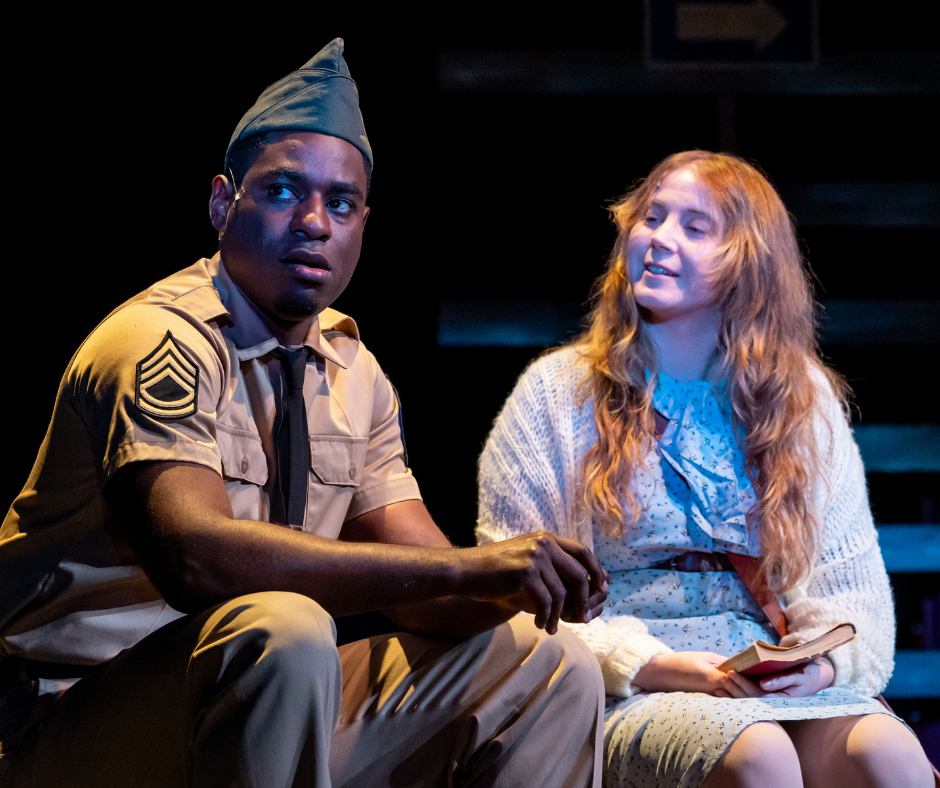
L to R: Rakeem Lawrence, Katelyn Kendrick | Photography credit: RDG Photography
Violet Karl (Katelyn Kendrick), a young woman from North Carolina, boards a Greyhound bus determined to reach the charismatic Preacher (Erik Sandvold) whose televised promises of healing have fueled her hopes of erasing the facial scar she’s carried since childhood. Along the way, she meets Flick (Rakeem Lawrence), a Black sergeant whose steadiness challenges her assumptions, and Monty (Adam Johnson), a cocky paratrooper whose charm complicates the journey. As Violet travels farther from home—haunted by memories of her Father (Trenton J. Schindele) and guided by the girl she once was (Meika Qutub)—her encounters force her to confront not only what she hopes to change, but what she’s never allowed herself to see.

L to R: Trenton J. Schindele, Adam Johnson, Katelyn Kendrick, Rakeem Lawrence, Meika Qutub | Photography Credit: RDG Photography
What lingers in Violet isn’t the scar we never see, but the way she’s learned to brace around it, which has become the quiet architect of her choices. Without a physical mark to point to, the audience is left watching how Violet carries the wound in her posture, in her quickness to judge herself, and in the way she sizes up the people who cross her path. Her early interactions with Flick are especially telling: she projects onto him the same scrutiny she dreads from others, assuming his Blackness is a barrier rather than a point of understanding. Flick, of course, knows something about being read before being known, and that recognition unsettles her in ways she can’t name. Monty, meanwhile, offers the easier escape hatch—the flattering distraction, the temporary balm that doesn’t ask her to look too closely at anything, least of all herself. Together, these two men sketch the fault line Violet must navigate: the difference between being seen and being chosen, and the harder work of choosing herself.
As Violet, Katelyn Kendrick anchors the production with a performance that feels lived‑in and quietly tenacious; their vocals carry both grit and ache, and their acting charts Violet’s inner weather with an honesty that never strains for effect. Rakeem Lawrence’s Flick emerges as a compelling presence in his own right, not through flash but through the clarity of his choices—he gives the often‑misread sergeant a grounded intelligence and emotional precision that make the character’s integrity unmistakable. And Adam Johnson brings an easy, undeniable appeal to Monty, letting the character’s charm land without sanding down his rougher edges; he understands that Monty’s allure is real, even when his certainty is misplaced.
In supporting roles, Erik Sandvold and Trenton J. Schindele each carve out memorable turns as the Preacher and the Father. Sandvold gives the Preacher a polished mix of showmanship and conviction, letting the character’s charisma land without tipping into caricature. Schindele, meanwhile, offers a Father shaped by equal parts tenderness and regret, grounding Violet’s memories with a presence that feels both protective and painfully human.
Tesori’s score remains one of the great pleasures of Violet—a rich, roots‑inflected tapestry that seems to rise up from the soil of the story itself. It’s music that carries its own emotional intelligence, shifting effortlessly from yearning to grit to something like grace. The book, by contrast, can feel a bit spare in places, its connective tissue stretched thin as Violet inches her way toward Tulsa and the promise of transformation. There are stretches where the journey slows, not because the stakes lessen, but because the script gives her fewer contours to push against. Still, the music keeps pulling her forward, offering the momentum the narrative occasionally withholds.
Ben Raanan’s direction gives Violet a clear emotional throughline, shaping the production with a steady hand and an eye for the small, revealing moments that accumulate along the journey. He draws honest, grounded work from his cast and keeps the staging fluid, even as the script itself lingers in that long middle stretch where time seems to dilate and the momentum softens. Music director Heather Iris Holt supports the storytelling with a sound that feels both rooted and responsive, while choreographer Carrie Colton threads movement through the piece with a light, intuitive touch. Together, they navigate the slower passages with as much intention as the material allows, guiding the audience through Violet’s interior landscape even when the book doesn’t always provide the propulsion one might hope for.
Scenic designer Nick Renaud provides a set that’s unfussy yet adaptable, giving the production a flexible physical world that easily shifts among the many locales Violet passes through. It’s especially effective in the way it uses the stage apron for the scenes between Father and young Violet, allowing those memories to sit just outside the main action, like thoughts she can’t quite outrun. Brett Maughan’s lighting adds welcome dimension throughout, sharpening emotional beats and subtly guiding the audience’s eye as the story moves across states and states of mind. And Alexandra Ligh’s costumes are a particular pleasure—smartly attuned to the period and thoughtfully calibrated to each character, they help root the production in its time without ever feeling like museum pieces.
This collaboration between Aurora Fox Arts Center and Phamaly Theatre Company ultimately shines brightly in its performances and the steady, thoughtful direction that frames them. The cast delivers work of real clarity and commitment, and the music—always one of Violet’s greatest assets—remains a powerful engine throughout. The script itself can feel a bit thin in places, especially as the story stretches across its long middle passage, but the production’s artistry consistently lifts the material. Violet plays through June 28 at the Aurora Fox Arts Center.
Information and tickets: https://www.aurorafoxartscenter.org/onstage/violet