
Review: Romeo & Juliet
Posted by Curtain Up! on Feb 16, 2026
Review: Romeo & Juliet | Arvada Center | Arvada, CO | Curtain Up! | Eric Fitzgerald
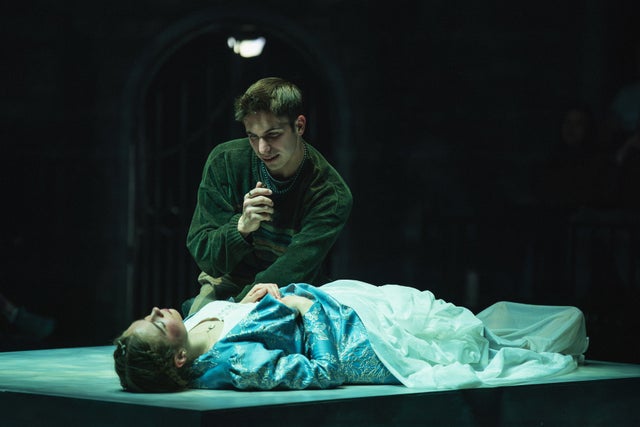
Henry Hawes and Julia McGowen as Romeo and Juliet
Romeo & Juliet by William Shakespeare opens at the Arvada Center’s Black Box Theatre in a tight production directed by Lynne Collins, who also serves as the Center’s Artistic Director. Running a quick one hour and forty minutes, with no intermission, Collins’s adaptation emphasizes the modern desire for shorter, actor-driven Shakespeare, where clarity, speed, and ensemble skill take priority over spectacle.
This lean approach puts the Arvada Center squarely in step with the broader shift toward reduced‑cast Shakespeare, where smaller ensembles and brisk, strategically trimmed scripts are fast becoming the rule rather than the exception. Companies such as Starling Shakespeare in Michigan have demonstrated just how much clarity, humor, and sheer theatrical play can emerge when a production is stripped to its essentials. And the no‑intermission format, once a novelty, now feels almost baked into contemporary practice: a way to keep the story hurtling forward, keep the audience locked in, and keep the evening from ballooning.
One of this production’s most striking choices is its approach to doubling: nearly everyone in the ensemble slips between roles except Romeo (Henry Hawes), Juliet (Julia McGowan), and—curiously—Tybalt (Kenny Fedorko). The lovers’ singular focus makes sense, of course, but leaving Tybalt undoubled gives his volatility a sharper edge, a kind of narrative weight that doesn’t dissipate the moment he exits. Around them, the rest of the cast moves with quick-change dexterity: Jacob Dresch toggles between the grounded wisdom of Friar Laurence and the blustering authority of Lord Capulet; Anne Penner shifts from the earthy, affectionate Nurse to a steely Lady Capulet; and Cameron Varner ricochets between Mercutio’s mercurial swagger and the Prince’s measured command. It’s the kind of doubling that doesn’t just cover logistical gaps—it becomes part of the production’s pulse, underscoring how much theatrical electricity can be generated by a nimble, tightly knit ensemble.
For those who don’t know the story: Romeo & Juliet unfolds in Verona, where the long‑simmering feud between the Montagues and Capulets keeps the streets on edge. Romeo, urged on by his steady, clear‑eyed friend Benvolio (Jenna Moll Reyes), crashes the Capulet ball and meets Juliet, whose world has been shaped by her family’s expectations and the ever‑present watchfulness of her Nurse. The clandestine marriage arranged by Friar Laurence sets off a chain of events that intensifies after Tybalt kills Mercutio. Exiled and desperate, Romeo learns of Juliet’s supposed death from his loyal messenger Balthasar (Chrys Duran), whose well‑intentioned report seals the lovers’ fate. By the time the Prince arrives to restore order, the cost of the feud has been laid bare in the bodies of the young couple who tried, briefly and bravely, to outrun it.
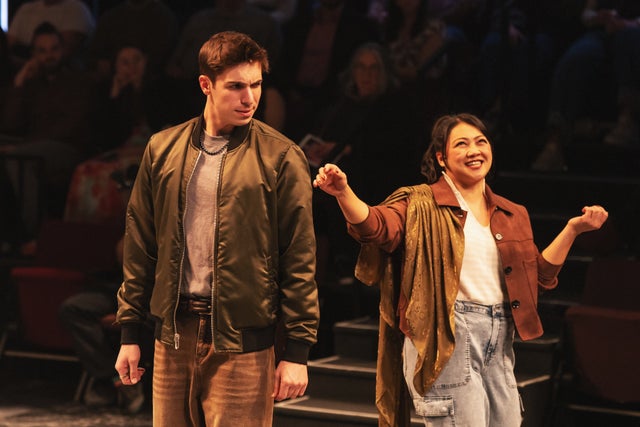
Henry Hawes as Romeo, and Jenna Moll Reyes as Benvolio
Both Henry Hewes and Julia McGowan bring appealing qualities to their roles: Hewes has an open, earnest presence that makes Romeo’s early infatuations feel genuine, and McGowan brings a bright, youthful spark to Juliet’s first steps into love. In a production built on velocity and precision, the lovers ideally serve as the gravitational force that holds the world in orbit; here, that pull is softer, giving the surrounding ensemble a bit more room to shape the momentum. Still, both actors approach the roles with clear commitment, and their work gives the production much of its emotional core.
Jacob Dresch, who plays both Friar Laurence and Lord Capulet, delivers some of the production’s most authentic emotional moments. As Capulet, Dresch channels every bit of a father’s fury during his confrontation with Juliet—a scene that hits hard in this intimate setting. As the Friar, he shifts to a softer tone, the well-meaning but ultimately ineffective peacemaker whose decisions accelerate the tragedy rather than prevent it. His performance highlights how powerful doubling can be when an actor clearly distinguishes between characters, letting each one resonate in a unique way.
Anne Penner, doubling as the Nurse and Lady Capulet, delivers two sharply etched characterizations that anchor the production whenever she’s onstage. As the Nurse, she brings an earthy warmth and comic ease that make her scenes with Juliet feel lived‑in and genuinely affectionate. Shift her into Lady Capulet, though, and the temperature drops: Penner finds a steely formality and social rigidity that stands in stark contrast to her earlier softness.
Collins’s direction drives the production at a breakneck pace, and there’s no denying the sheer propulsion she brings to the story. The momentum is invigorating, giving the evening a clean, muscular sweep that keeps the audience alert and the narrative sharply in focus. Some of Shakespeare’s more profound emotional beats do fly past almost before they land, but that seems part of the design: a high‑velocity approach that privileges clarity, immediacy, and forward motion. And on that front, the production delivers, tying everything up neatly in just over a hundred minutes—no intermission, no drift, no excess. It’s an efficient, streamlined take that favors momentum over meditation, even if a few deeper moments might have benefited from a breath or two more.
A well‑deserved shout‑out goes to Carrie Colton for the fight choreography, which is plentiful and often harrowing. Working primarily with knives and daggers, she crafts sequences that feel tight, dangerous, and dramatically charged—no small feat in the close quarters of the Black Box. The fights have a visceral snap, giving the production an added jolt of tension. That charge is amplified by Max Silverman’s original music and sound design, which threads through the evening with a steady, atmospheric pulse. His work elevates the production throughout, sharpening the stakes and underscoring the danger that seems to hover just offstage.
Pinning down the production’s timeframe is tricky; it never felt Elizabethan, even though some elements were present. Sarah Zinn’s costumes offered the most consistent visual thread, giving the world a unified look even as the period cues shifted. The set, designed by Matthew S. Crane, was mostly practical, worked well, was clean and flexible, and was anchored by the essential balcony for one of Shakespeare’s most famous scenes. Lighting, designed by Kate Bashore, meanwhile, was atmospheric and subtly sculptural, shaping mood and space without calling attention to itself. Overall, the design team created a world that supported the production’s pacing while adding enough texture to keep it grounded.
Lynn Collins’s direction makes a clear, conscious choice to drive Romeo & Juliet forward at high speed and on its own terms; that choice works: the evening moves with purpose, clarity, and a sharp, forward‑thrusting rhythm that keeps the audience engaged. Yes, that velocity sometimes comes at the expense of the deeper textures embedded in Shakespeare’s script, but the production compensates with strong performances—particularly from those tasked with doubling—who bring definition and vitality to the world around the young lovers. Taken as a whole, Romeo & Juliet becomes an important production that lands squarely in the ongoing conversation about how we stage Shakespeare now: leaner, faster, and powered by the ingenuity of a committed ensemble.
For Information and Tickets: https://arvadacenter.org/events/romeo-and-juliet