
Review: White
Posted by Curtain Up! on Apr 07, 2026
Review: White | John Hand Theater, Firehouse Theater Company | Denver, CO | Curtain Up! | Eric Fitzgerald

White, James Ijames’s sharp, probing comedy about race, art, and the peculiar nuances of “allyship,” premieres at Firehouse in a production at John Hand Theater directed by Artistic Director Julie K Wolf that matches the script’s intelligence with a clear, steady confidence. Ijames creates a minefield of tone and intention, and Wolf guides the cast through it with an ease that feels both purposeful and a little mischievous. The result is staging that actively engages with the play rather than avoiding its cleverness, addressing its smart writing with just enough edge to keep everyone honest.
James Ijames—Pulitzer‑winning playwright of Fat Ham, now onstage at Aurora Fox—first premiered White at Theatre Horizon in 2017, where its sharp, satirical take on race, art, and representation quickly marked it as one of his signature early works. Though White never made a Broadway run, Ijames’s profile has only grown, with plays like Kill Move Paradise, Moon Man Walk, and the Broadway transfer of Fat Ham solidifying his reputation as one of the most inventive, incisive voices in contemporary American theatre.
White follows Gus (Andrew Catterall), a white artist who feels shut out of the museum world, as he turns to Tanner (Timmy Pamintuan)—his partner in ways that are both romantic and creatively entangled—to help him respond after Jane (Maya Ferrario), the new curator, rejects his work for lacking “diversity.” Enter Vanessa (Kenya Mahogany Fashaw), an actor Gus hires to embody a bold new persona named Balkonaé Townsend, a creation that quickly grows beyond anyone’s control. As Jane, Gus, Vanessa, and Tanner collide over ambition, identity, and the politics of visibility, the play drives them toward an ending that unsettles every assumption they’ve been clinging to, without giving away exactly how Ijames lets the final blow land.
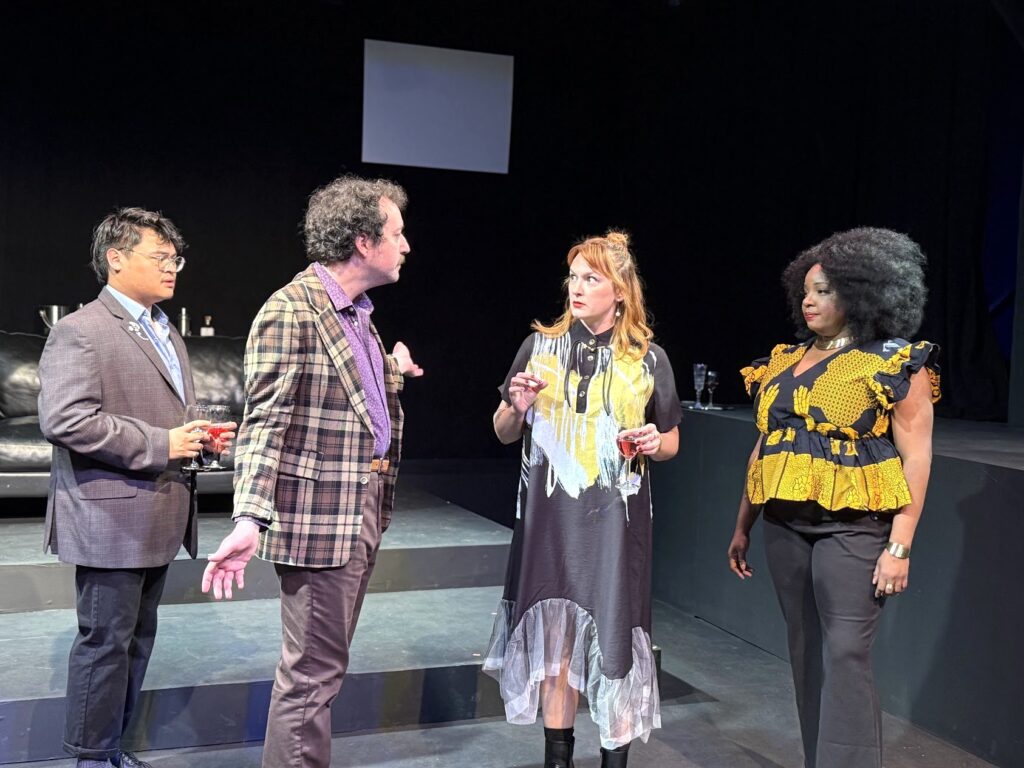
L to R: Tanner (Timmy Pamintuan), Gus (Andrew Catterall), Jane (Maya Ferrario), Balkonaé (Kenya Mahogany Fashaw) | Photography credit: Soular Radiant Photography
White digs into the uneasy space where privilege starts to sweat. Ijames isn’t really arguing that Gus is discriminated against; he’s far more interested in what happens when a white man feels the center of the room shift and suddenly wants the language of marginalization for himself. The play pokes at the art world’s obsession with optics, the slippery performance of allyship, and the way identity gets packaged, sold, and sometimes weaponized. Race, desire, ambition, and authenticity all get tangled together, and Ijames lets the mess stay messy—funny, pointed, and uncomfortably recognizable.
Kenya Mahogany Fashaw is a force across all three of her roles—Vanessa, Balkonaé, and Saint Diana—shifting among them with a command that feels effortless and sharply tuned. As Vanessa, she brings a cool, incisive authority that grounds the play’s chaos; as Balkonaé, she unleashes a wild, theatrical charge; and as Saint Diana, she offers a sly, affectionate homage to Diana Ross that lands with just the right shimmer. Fashaw doesn’t just differentiate the characters; she energizes the space between them, giving the production a pulse that never lets up.
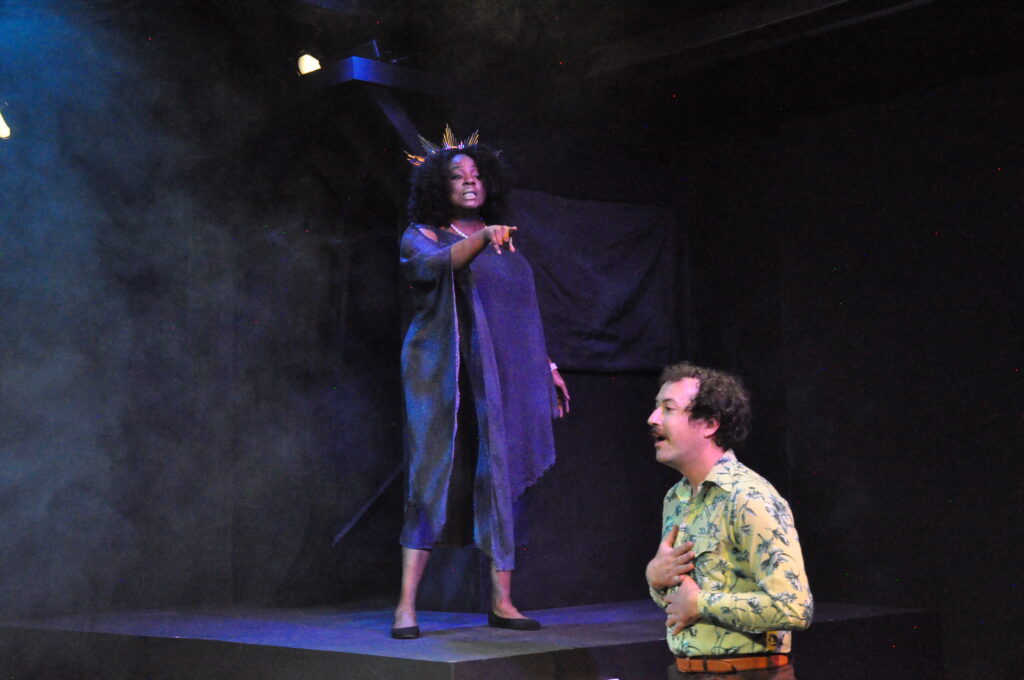
L to R: Saint Diana (Kenya Mahogany Fashaw) and Gus (Andrew Catterall) | Photography credit: Soular Radiant Photography
Andrew Catterall gives Gus a jittery mix of entitlement and vulnerability that makes his spirals both funny and uncomfortably familiar. Maya Ferrario’s Jane is a sharp, steady presence, the kind of friend who sees more than she says, and her timing keeps the play’s reality anchored. And Timmy Pamintuan brings Tanner a quiet emotional intelligence that deepens every scene they touch, especially as the lines between love, loyalty, and artistic ambition start to blur. Together, they form a trio that keeps the play’s stakes human even as the satire sharpens.
Julie K Wolf’s direction gives White the clarity and tension it needs without ever overplaying its hand. She keeps the satire sharp but grounded, letting the absurdity bloom naturally out of the characters rather than forcing the joke. Scenes shift with an ease that feels intentional rather than slick, and she trusts the actors enough to let their choices breathe. What emerges is a staging that’s alert to the play’s provocations but never intimidated by them—clean, confident work that lets Ijames’s script land exactly where it wants to.
Although not credited in the program, the scenic design—built by Jeff Jesmer—proves both nimble and quietly effective, giving the actors a space that shifts tone without ever calling attention to itself. Emily Maddox’s lighting, everywhere these days and currently on full display in Angels in America at Vintage Theatre, brings her signature precision and emotional shading to the production. And Madison Kuebler’s sound design threads the whole thing together with a subtlety that supports the satire rather than decorating it.
Under Julie K Wolf’s confident, quietly adventurous direction, White finds the sharpness and control the play needs to truly hit home. Kenya Mahogany Fashaw’s trio of characters—Vanessa, Balkonaé, and Saint Diana—remains the production’s energetic core, a vivid reminder of how much Ijames’s satire depends on actors who can navigate its tonal shifts with both wit and generosity. As the evening progresses, the play’s larger argument becomes clear: a pointed, funny, and unsettling exploration of how identity, privilege, and artistic ambition constantly clash in the spaces where we most want to believe we’re making a difference. It’s a testament to Ijames’s craft—and to this company’s thoughtful approach—that these questions stay with you long after the lights come up, making this a production worth seeking out.
Information and tickets: https://www.firehousetheatercompany.com/white/