
Review: Waiting for Godot
Posted by Curtain Up! on Feb 03, 2026
Review: Waiting for Godot | Aurora Fox Arts Center | Aurora, CO | Curtain Up! | Eric Fitzgerald
Every so often, a theatre offers a gift you don’t dare take for granted, and Aurora Fox is doing exactly that with its new production of Waiting for Godot. Samuel Beckett’s landmark absurdist masterwork is rarely staged, and rarer still in a production as clear‑eyed and top‑notch as the one Rodney Lizcano has assembled. This is the kind of opportunity that reminds you why the play endures: two men waiting for someone who never arrives, circling hope and despair with a strange, irresistible rhythm—and here, that rhythm is played with precision, humor, and a startling amount of heart.
When Waiting for Godot premiered in the 1950s, it upended every expectation of what theatre was supposed to do. Beckett’s absurdist landmark—two men waiting for someone who may never arrive, filling the hours with scraps of memory, banter, and existential dread—became a touchstone for modern drama, a play that dared to say that meaning is something we invent moment by moment. What it brings to today’s audience is surprisingly direct: in an age defined by uncertainty, stalled momentum, and the uneasy hum of “what now,” Godot feels less like a relic and more like a mirror. Its humor, its ache, and its strange, looping hopefulness land with a clarity that speaks to our own suspended moment in time.
Rodney Lizcano’s direction gives this Godot a taut, straightforward core. He avoids the temptation to modernize the play or add layers of tension that Beckett never intended, instead trusting the original instincts that sustain the piece. Lizcano keeps the staging simple and precise, letting the language, silences, and strange, cyclical rhythms speak for themselves. It’s a production that respects Beckett’s vision without feeling overly formal—a director confident enough to stay out of the way and let the play’s stark humanity speak.
Two of the finest actors working in the region anchor the production as Vladimir (Matthew Murry) and Estragon (Andrew Uhlenhopp). Each has carved out a clear, compelling throughline for his character, moving the action forward without ever editorializing the circumstances or tipping the play toward sentiment it doesn’t earn. Murry’s watchful intelligence and Uhlenhopp’s restless physicality create a partnership that feels both inevitable and constantly surprising, a pairing that honors Beckett’s design while giving the evening its pulse.
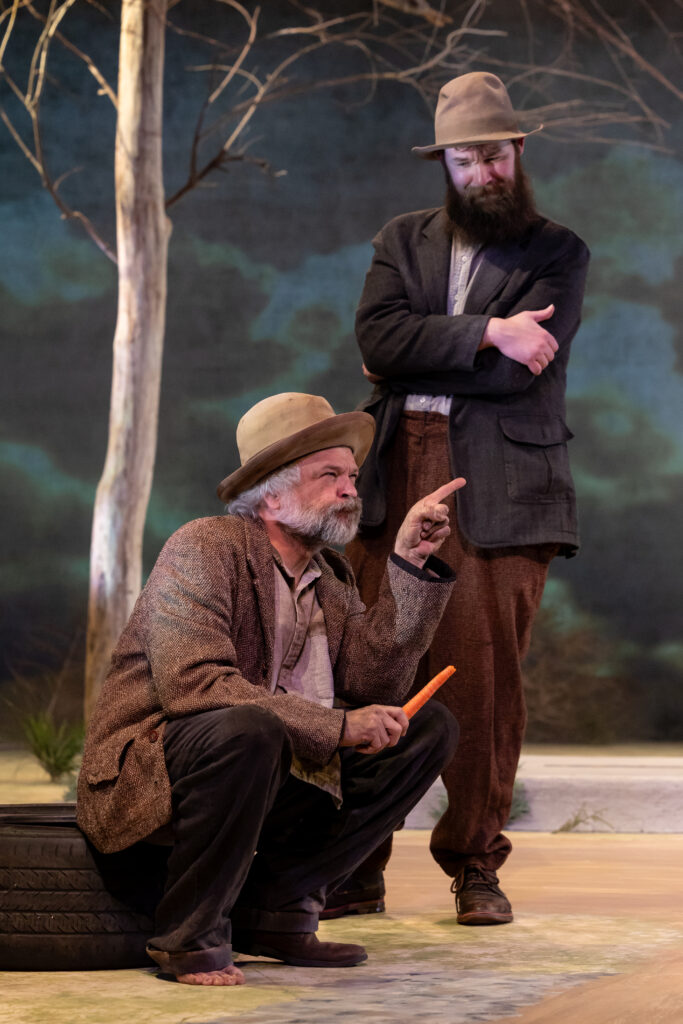
Andrew Uhlenhopp and Matthew Murry as Estragon and Valdimir | Photo credit: RDGPhotography.
Antonio Minino delivers a full‑throated, gloriously theatrical Pozzo, a performance that leans into the character’s bombast without ever losing the darker undercurrent that threads beneath the swagger. Opposite him, David Stallings gives a riveting turn as Lucky, culminating in that famously unspooled monologue—a torrent of seemingly nonsensical language that, in his hands, becomes oddly hypnotic and ultimately disarming. Together, they sharpen the play’s edges, reminding us that Godot is as much about the fragility of power as it is about the ache of waiting.
Max Rynerson makes a strong impression as Boy, delivering his brief scenes with quiet sincerity. His arrival—and the simple, unsettling message he carries—reminds us that Godot hinges on the fragile hope that keeps Vladimir and Estragon rooted in place. Ryerson plays the moment without embellishment, giving the script exactly what it needs: a flicker of possibility that both steadies and destabilizes the world Beckett has built.
The physical production begins with Nicholas Renaud’s scenic design: a dusty, desolate landscape that feels suspended outside time. It’s a stark, almost chalk‑dry setting that gives Vladimir and Estragon the perfect canvas on which to swirl through their days—waiting, circling, doubling back, and waiting some more. The simplicity of the environment is its strength; it holds the characters without defining them, allowing Beckett’s strange, revolving world to settle in around the audience with quiet inevitability.
Linda Morken’s costumes strike just the right balance between the familiar and the faintly otherworldly, grounding the characters in a reality that always feels a half‑step removed. Brett Maughan’s lighting sharpens that effect, carving out pockets of shadow and illumination that echo the play’s shifting moods without ever tipping into overstatement. And John Hauser’s sound design threads through it all with a subtle, atmospheric touch—never intrusive, always suggestive—quietly reinforcing the sense of a world that hums along even as Vladimir and Estragon remain suspended in their endless wait.
In the end, Waiting for Godot reminds us how much of our own lives are spent in a kind of suspended motion—hoping, anticipating, bracing for the thing that may or may not arrive. Rodney Lizcano’s direction brings that truth into sharp relief, not with heaviness but with clarity, and he’s assembled an extraordinary ensemble to carry it. This is an excellent opportunity to experience Samuel Beckett’s classic absurdist play in a full, rigorously realized production, the kind we don’t often get to see.
For information and tickets: https://www.aurorafoxartscenter.org/onstage/godot