
Posted by Curtain Up! on Sep 02, 2026
Review: Topdog/Underdog | Curious Theatre Company | Cleo Parker Robinson Dance’s Historic Shorter AME Building | Denver, CO | Curtain Up! | Eric Fitzgerald
Curious Theatre Company’s production of Suzan‑Lori Parks’ Pulitzer Prize-winning play, Topdog/Underdog, settles into the evocative confines of Cleo Parker Robinson Dance’s Historic Shorter AME Building, a temporary home that lends the production a sense of transition and charged possibility. Under Steven Sapp’s direction, the play’s two‑brother dynamic unfolds with a taut, lived‑in immediacy—its entire world distilled into the volatile push‑and‑pull between siblings who know each other too well and not well enough. The venue and the stripped‑down structure work together in a way that feels purposeful, tightening the play’s focus and giving the two brothers a space that reflects just how unstable their world really is.
Lincoln and Booth are at the center of Parks’ spare, electric drama: Lincoln (Cajardo Lindsey), who once earned his keep by impersonating Abraham Lincoln, carries the weight of a performed identity and a battered dignity; Booth (Rakeem Lawrence), his younger brother, is a restless hustler obsessed with the three‑card monte and the quick promise of cash and control. Their conversations and confrontations turn ordinary objects into emblems—the Lincoln costume and makeup as a fragile mask of respectability, the three‑card monte as a ritual of illusion and survival, and the recurring references to names and roles as a darkly comic commentary on history, betrayal, and aspiration. As the brothers jockey for dominance, memory and myth blur, and Parks uses the game’s sleight of hand to expose how identity, luck, and performance shape who wins, who loses, and what it costs to keep playing.
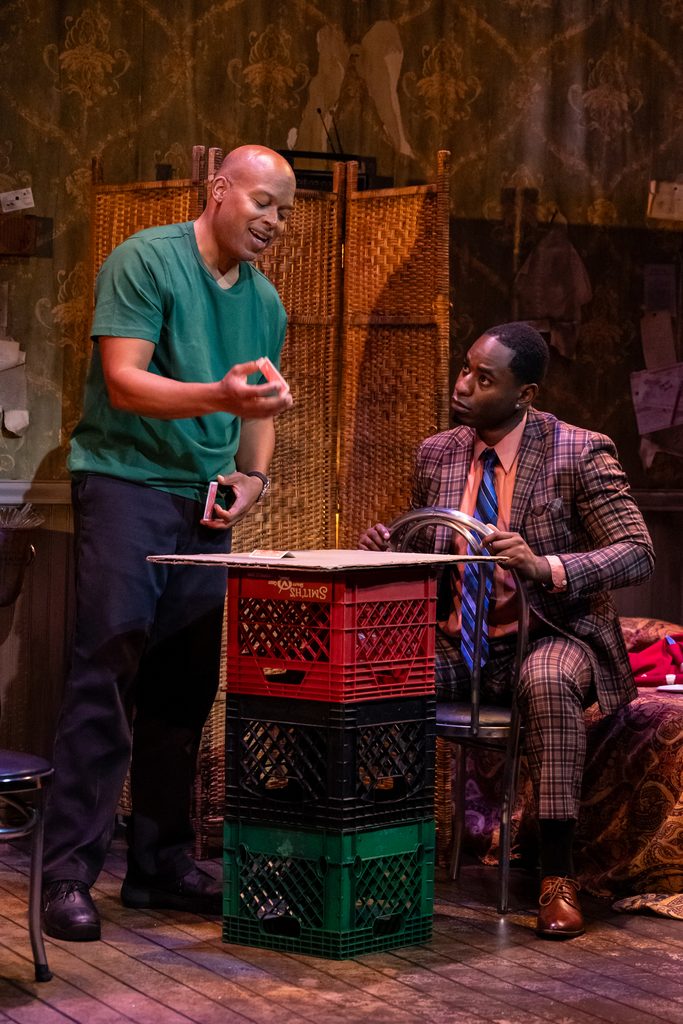
Cajardo Lindsey and Rakeem Lawrence | Photography Credit: RDG Photography
Suzan‑Lori Parks’ writing in Topdog/Underdog is spare, rhythmic, and fiercely theatrical—language that compresses history, humor, and pain into sharp, often oblique exchanges—so that every line functions as both dialogue and metaphor. Under Steven Sapp’s deft direction, the text is given room to breathe in the Historic Shorter AME Building: he favors close, physical staging and a careful ear for Parks’ cadences, using the venue’s intimacy, echoes, and narrow sightlines to intensify the brothers’ fraught relationship. Sapp trusts silence and small gestures, letting pauses and physical detail carry emotional weight and allowing the play’s formal precision to emerge through performance rather than exposition.
Cajardo Lindsey gives Lincoln a worn, deliberate gravity that feels immediately recognizable—the kind of presence that suggests a man who’s been carrying more than he ever says out loud. He lets Lincoln’s humor surface in quick, dry flashes, and when the character’s guard drops, the vulnerability underneath feels earned rather than performed. Rakeem Lawrence, as Booth, meets that steadiness with a restless, almost combustible energy. His Booth is sharp, funny, and impulsive, but Lawrence also threads in the quieter beats—the longing, the insecurity, the need to be seen—that keep the character from tipping into caricature. Together, they build a rhythm that feels lived‑in and deeply human, the kind of sibling dynamic where affection, rivalry, and old wounds sit right on top of each other, shaping every moment they share onstage.
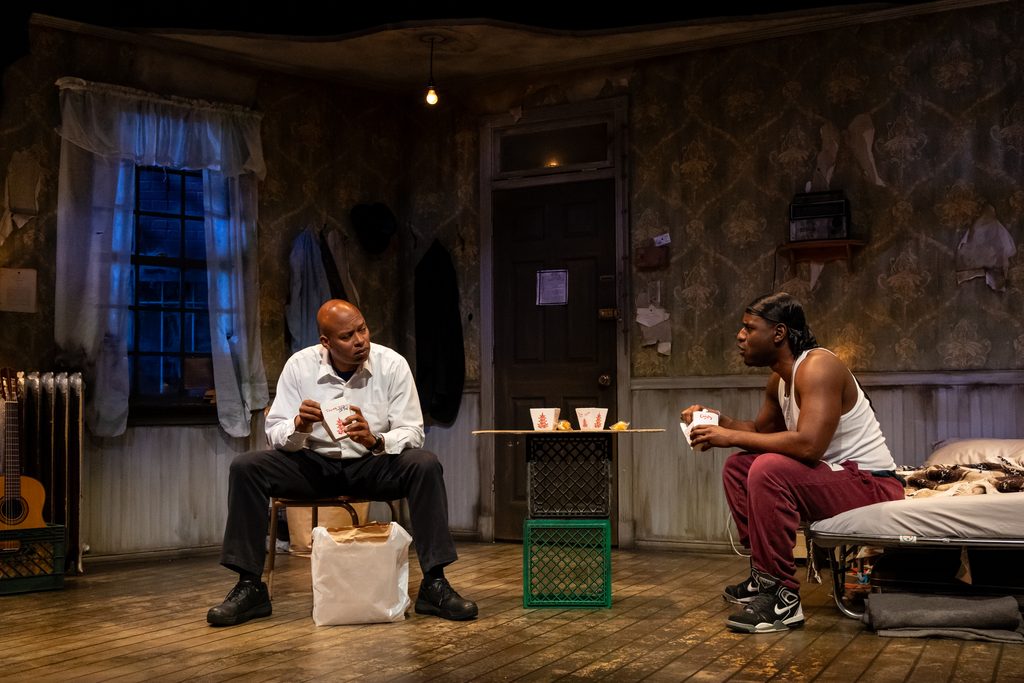
Cajardo Lindsey and Rakeem Lawrence | Photography Credit: RDG Photography
Tina Anderson’s scenic design gives the production a clear visual anchor, shaping the brothers’ cramped world with an eye toward both function and tension; the space feels lived‑in without ever losing its theatrical edge. Erin Carignan’s costumes deepen that sense of character, offering subtle cues about each brother’s aspirations and self‑mythology through fit, texture, and wear. Jonathan Spencer’s lighting moves fluidly between naturalism and heightened mood, sharpening shifts in tone and giving the actors a strong visual frame in a venue that rewards precision. Max Silverman’s original music and sound design weave quietly through the production, adding atmosphere without overwhelming the play’s intimacy, while Annette Westerby’s property design fills out the environment with details that feel specific and purposeful, grounding the action in a reality that Parks’ language can push against.
The production builds toward an ending that feels both inevitable and startling—charged without tipping into spectacle and shaped with a restraint that lets its emotional impact land cleanly—yet when the final moment arrives, its abruptness and sheer terror hit with a force that’s hard to shake. Steven Sapp’s direction keeps the tension simmering right up to that final turn, guiding the actors with a clarity that makes the conclusion feel earned rather than engineered. Lindsey and Lawrence meet the moment with performances that stay rooted in character even as the stakes rise, giving this first Curious Theatre Company staging of Topdog/Underdog at the Cleo Parker Robinson Historic Shorter AME Building a finish that resonates long after the lights fade.
For Information and Tickets: https://purchase.curioustheatre.org/EventAvailability?EventId=25001