
Review: Pump Boys and Dinettes
Posted by Curtain Up! on Apr 29, 2026
Review: Pump Boys and Dinettes | Miners Alley Performing Arts Center | Golden, CO | Curtain Up! | Eric Fitzgerald
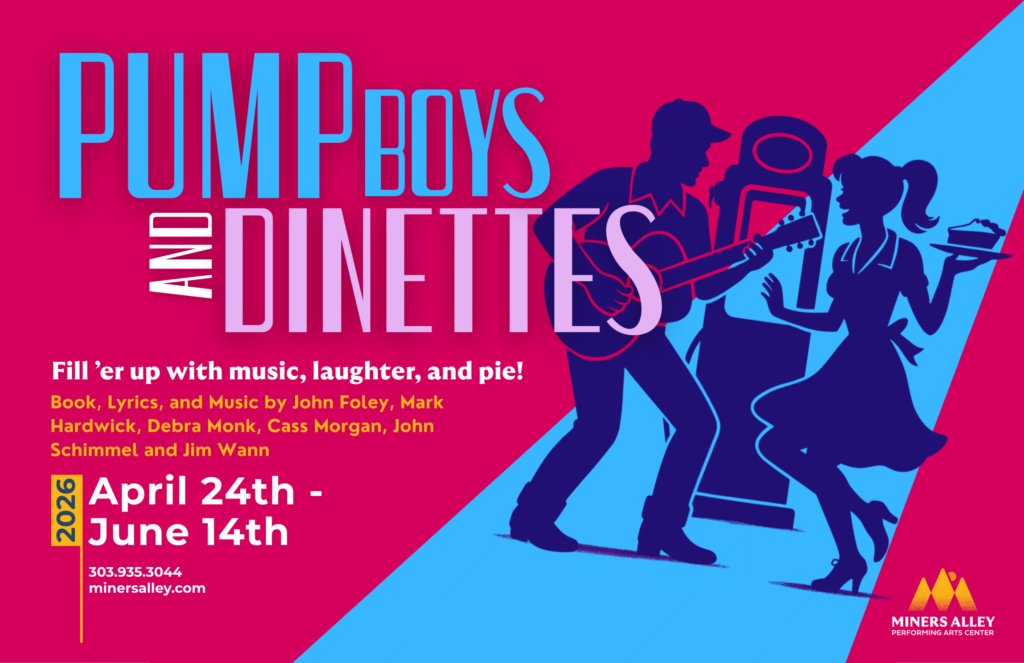
At Miners Alley Performing Arts Center, Pump Boys and Dinettes rolls in like a well‑tuned Chevy, and under the sure‑handed direction of longtime Denver standout Abby Apple Boes, the evening becomes a kind of theatrical time machine—one that eases you back into an era when a gas station, a diner, and a good song could carry the whole night. With Neal Dunfee guiding the music from the inside, the show’s sound has an easy, lived‑in confidence that deepens the whole experience. And if there’s a single word that captures the production’s spirit, its energy, and its easygoing charm, it’s this: FUN.
What Miners Alley offers is less a book musical than a front‑porch hangout with six performers who play, tease, harmonize, and swap stories with the kind of easy rapport that can’t be faked. Pump Boys and Dinettes has always lived or died on the chemistry of its ensemble, and this cast leans into the show’s built‑in looseness—the sense that you’ve wandered into a place where the coffee’s strong, the guitars are tuned, and the evening unfolds at the speed of genuine camaraderie.
Pump Boys and Dinettes has its roots in a scrappy, musician‑driven act that grew into a full‑fledged musical created and originally performed by its own writers. Conceived by John Foley, Mark Hardwick, Debra Monk, Cass Morgan, John Schimmel, and Jim Wann, the show began as a blend of gas station humor, diner counter storytelling, and country-inflected tunes that the group developed while performing together in New York. What started as a small, good‑natured cabaret act eventually made its way to Broadway in 1982, carrying with it the same easy charm and front‑porch spirit that still define the piece today.
The six performers at Miners Alley (most of them are returnees to Miners Alley) make easy work of the show’s musician‑actor tightrope. Mark Collins sets the tone as Jim, the steady hand behind the counter, his vocals carrying that unforced, lived‑in ease the role needs. Damon Guerrasio, as Jackson, brings a kind of magnetic looseness—there’s an easy, good‑natured swagger to him that draws focus the moment he steps in, and the stage seems to widen around him. Aaron Szindler’s Eddie adds a welcome streak of sweetness, his musicianship anchoring the ensemble. On the diner side, Susannah McLeod’s Prudie is all spark and precision, while Julia Tobey’s Rhetta delivers the kind of vocal power and comic instinct that makes you wish the show gave her three more numbers. And presiding over it all is Neal Dunfee as L.M., doubling as Music Director, whose steady musicianship keeps the whole evening humming.
The score itself provides much of the evening’s lift, and Pump Boys and Dinettes gives this cast plenty to dig into. Highlights include the sly swagger of “The Best Man,” the bright jolt of “Sister,” the gently comic storytelling of “The Night Dolly Parton Was Almost Mine,” and the crisp, good‑natured bounce of “Tips.” And when the ensemble comes together for numbers like “Highway 57,” “Drinkin’ Shoes,” and the show’s other full‑company tunes, the production hits that sweet spot where musicianship and camaraderie fold into one another—six performers trading rhythms, harmonies, and sheer goodwill. Kudos to the entire cast!
Director Abby Apple Boes leans into the show’s built‑in nostalgia without ever letting it calcify, shaping the evening with the ease of someone who genuinely remembers the cultural air of the late ’70s and early ’80s. In her program notes, she nods to the era of Hee Haw, The Smothers Brothers, and The Glen Campbell Show—not as a gimmick, but as the backdrop for a kind of homespun variety‑hour looseness that suits Pump Boys and Dinettes perfectly. You can feel that influence in the pacing, the gentle humor, and the way the performers are allowed to simply be themselves onstage, instruments in hand. Boes’s touch is light but assured, guiding the production toward something that feels less like a reconstruction of the past and more like a fond, good‑natured return to the kind of entertainment that didn’t need much more than a tune, a story, and a group of people happy to share both.
Tina Anderson’s scenic design serves the production beautifully, splitting the stage between the Pump Boys’ service station and the Double Cupp Diner in a way that’s clearly defined yet still reads as a single, shared world. It’s an arrangement that lets the performers move easily between the two spaces while keeping the show’s gentle back‑and‑forth rhythm intact. Crystal McKenzie’s workplace costumes land right in that late ’70s/early ’80s pocket, grounding the characters in something that feels both period‑true and unmistakably local. Vance McKenzie’s lighting adds warmth and subtle shifts of mood—never calling attention to itself but always guiding the eye—and John Hauser’s sound design keeps the balance crisp, allowing the onstage instruments and vocals to blend cleanly without losing the show’s easy, front‑porch looseness. The entire production is anchored by stage manager and props designer Samantha Piel, whose steady hand ensures the world of the show runs as smoothly as the music itself.
What ultimately carries this Pump Boys and Dinettes is the cast itself—Mark, Damon, Aaron, Susannah, Julia, and Neal—a group that moves easily between the show’s big, showy bursts of energy and its quieter, more reflective stretches. They play, they sing, they joke, they lean into the material with an open‑hearted gusto that feels rare these days. And while Abby Apple Boes’s direction gives the evening its shape, it’s the ensemble’s collective spark that keeps it humming. In the end, the word that still fits best is FUN—uncomplicated, good‑natured, fully earned fun. This is one not to be missed, playing through June 14 at the Miners Alley Performing Arts Center.