
Review: I’m Harvey Milk
Posted by Curtain Up! on Jul 21, 2026
Review: I’m Harvey Milk | Act One Productions & Theatrix USA along with Colorado TINTS | Denver, CO | Curtain Up! | Eric Fitzgerald
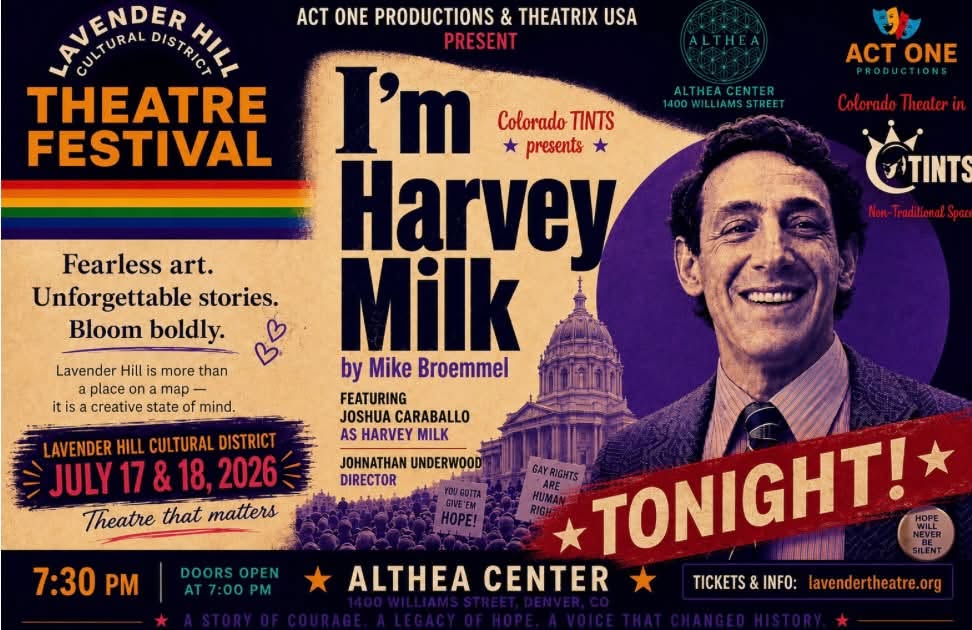
Mike Broemmel’s I’m Harvey Milk arrives as a vivid, deeply felt homage to one of America’s most consequential civil‑rights leaders, presented as part of the Lavender Festival in partnership with Act One Productions and Theatrix USA along with Colorado TINTS. Under the multi‑talented guidance of director, producer, actor, and costumier Johnathan Underwood, the piece played two powerful performances at the Althea Center for Engaged Spirituality, offering audiences a sharply drawn, emotionally resonant portrait of Milk’s courage and legacy. Broemmel’s script, paired with Underwood’s sure‑handed staging, creates an experience that feels both intimate and urgent—an artistic tribute that honors Milk’s voice while reminding us how fiercely it still echoes today.
At the center of I’m Harvey Milk is Joshua Caraballo, delivering a portrayal of Harvey Milk that is profoundly impactful and irresistibly compelling. Caraballo brings a luminous sincerity to the role—an emotional clarity and grounded warmth that make Milk’s optimism, vulnerability, and moral fire feel newly alive. As the founder of Ruby Hill Productions, a community‑driven theatre company dedicated to human betterment, Caraballo carries that mission into his performance; his work here feels not only skillful but purpose‑driven. For nearly two hours, his sharp, beautifully sustained presence graced the stage, guiding the audience through Milk’s journey with a steady hand and an open heart.
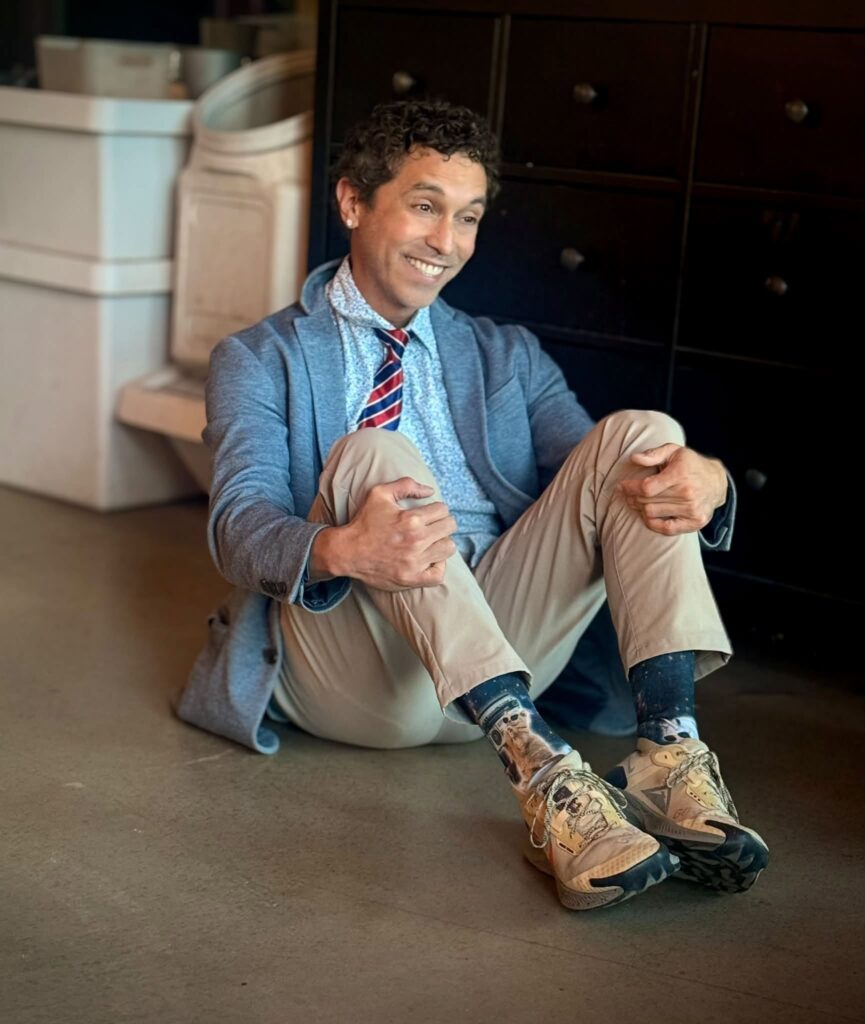
Joshua Caraballo as Harvey Milk | Photo courtesy of Johnathan Underwood
Harvey Milk’s journey begins in New York, where he grew up in a tight‑knit Jewish family and carved out early careers in teaching, finance, and the arts before restlessness—and possibility—pulled him west. His move to Los Angeles marked a turning point, a widening of both his world and his courage, eventually leading him to San Francisco’s Castro District, where he became known affectionately and defiantly as “the Mayor of Castro Street.” From that vibrant enclave he championed queer rights with a blend of humor, grit, and unshakeable hope, reshaping the political landscape with every step. And then, in a moment that still feels like a tear in the nation’s fabric, his life was violently cut short in an assassination that transformed him from local hero into an enduring symbol, a voice silenced but never extinguished.
Broemmel’s script offers a solid, thoughtfully rendered recollection of Milk’s life, much of it illuminated through the people who shaped his brief but blazing trajectory. He traces Milk’s often‑fraught romantic relationships with a clear, compassionate eye, reminding us that in an era when living openly was dangerous rather than liberating, queer love required both courage and compromise. Broemmel also touches on Milk’s service in the United States Navy, a chapter that adds complexity to his evolving sense of duty and identity. In one of the script’s more intriguing historical parallels, he references the assassination attempts on President Gerald R. Ford—moments that may well have sharpened Milk’s awareness of his own rising visibility and the risks that accompanied it. And in a pointed narrative turn, Broemmel includes a “tribute” to Anita Bryant, the pop‑culture crusader whose anti‑gay activism stood in stark opposition to Milk’s fight for equality. The result is a script that feels both personal and historical, a clear‑eyed portrait that honors Milk’s humanity while situating his legacy within the turbulent landscape of American queer rights.
Johnathan Underwood’s direction is purposeful, imaginative, and strikingly attuned to the emotional contours of Milk’s story. He uses the generous open-format stage at the Althea Center to its fullest advantage, shaping the space with fluidity and intention so that each moment feels both intimate and expansive. What emerges is the work of an artist who clearly holds deep affection for Harvey Milk and for the place Milk occupies in queer history; Underwood directs not just with skill, but with conviction. His staging honors Milk’s legacy by giving it room to breathe, resonate, and reach the audience with clarity and heart. Underwood’s growing importance to the Denver theatre scene is unmistakable, a multi‑hyphenate force whose work as producer, director, actor, and costume designer continues to deepen and elevate the city’s artistic landscape.
There are no formal credits for the physical aspects of the production, and what Underwood assembled was intentionally stark, a bare setting supported by rudimentary lighting that, while simple, never distracted from the storytelling. As Milk, Joshua Caraballo spent most of the evening in a suit and tie, accented with small, thoughtful alterations that subtly marked shifts in time and tone. The minimalism proved effective; in the flexible space of the Althea Center, these understated choices allowed the performance itself to remain front and center, giving Milk’s words and Caraballo’s presence the room they needed to resonate.
In 2026, telling Harvey Milk’s story feels not only meaningful but necessary—a gentle, insistent reminder of the long, courageous road the queer community has traveled and the voices that carved its earliest pathways. Broemmel’s incisive script, Underwood’s purposeful direction, and Caraballo’s deeply felt performance combine to create an evening that honors Milk with clarity, conviction, and heart. It is regrettable that I’m Harvey Milk was limited to only two performances, especially given the power and relevance of its message.
Audiences will have another chance to experience Broemmel’s work on July 26 at the Althea Center with a one‑night staging of The Wind Is Us: The Death That Killed Capote, a piece that will undoubtedly cast fresh light on the iconic figure of Truman Capote and the complicated brilliance he left behind.