
Posted by Curtain Up! on Oct 17, 2026
Review: Tiny Beautiful Things | Phamaly Theatre Company | People’s Building, Aurora, CO | Curtain Up | Eric Fitzgerald

Phamaly Theatre Company’s Tiny Beautiful Things, directed by Stacey D’Angelo, turns The People’s Building into a living chorus of voices — well over a hundred actors, some familiar, some brand new, all stepping forward as the people who write to Sugar, the anonymous advice‑giver at the center of Cheryl Strayed’s bestselling collection. Nia Vardalos adapts the play for the stage, gathering these seekers around Sugar as they search for something steady, honest, or simply human. The sheer scale of the ensemble gives the production its pulse; each voice feels like another heartbeat in the room, another reminder of how many ways people reach out when life tilts sideways.
Phamaly’s long‑standing mission to center artists with disabilities and model a disability‑affirmative process is present, of course, but what’s striking here is how naturally it folds into the production rather than overshadowing it. Tiny Beautiful Things doesn’t ask for special consideration; it earns its impact through Stacey D’Angelo’s clear direction, Ben Raanan’s striking videos, and the sheer range of performances onstage and on camera. The company’s values shape the environment, but the work itself stands on its own — honest, textured, and fully engaged with the material.
Tiny Beautiful Things unfolds as a series of people reaching out to Sugar, each carrying a story that’s heavier than they know how to hold. Some write in with everyday confusion, some with heartbreak that sits right at the surface, and some with wounds that never stopped bleeding. Among them is the father who lost his son to a drunk driver, a man whose grief arrives with a kind of stunned clarity that reshapes the room. Others come forward with questions about love, shame, forgiveness, or simply how to keep going. Together, their voices form the play’s mosaic — a chorus of strangers asking for help and a reminder of how many ways people try to make sense of their lives.
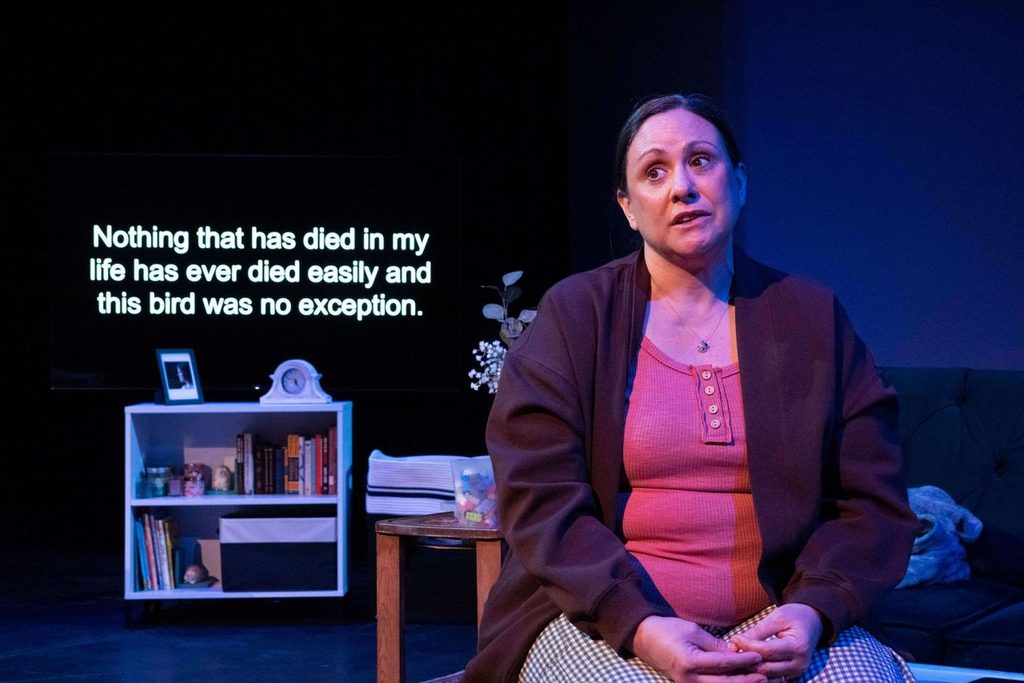
Adrienne Asterita as Sugar | Photography credit: Michael Ensminger Photography
At the performance I attended, Sugar was played by Adrienne Asterita (alternating with Jessica Swanson), and Ms. Asterita’s work was both soulful and steady‑burning — the kind of presence that doesn’t announce itself so much as accumulate. Her interactions with the video components give her character a quiet evolution; each new face, each new plea projected around her seems to shift her center of gravity a little. You can see her absorb these stories, recalibrate, and find a deeper register of empathy as the night goes on. It’s a performance built on responsiveness — to letters, to technology, and to the emotional weight of being Sugar in a room full of people asking for something they can barely name.
The many actors who fill the large video screen — most from Phamaly, some not — create a visual tide of humanity that’s hard to ignore. Their sheer number becomes its own kind of storytelling, a reminder of how many people carry private questions, quiet grief, or the simple need to be heard. It’s a lot by design, and the accumulation of faces gives the production a wider frame, suggesting a world crowded with longing and uncertainty, all of it converging on Sugar in search of something steady.
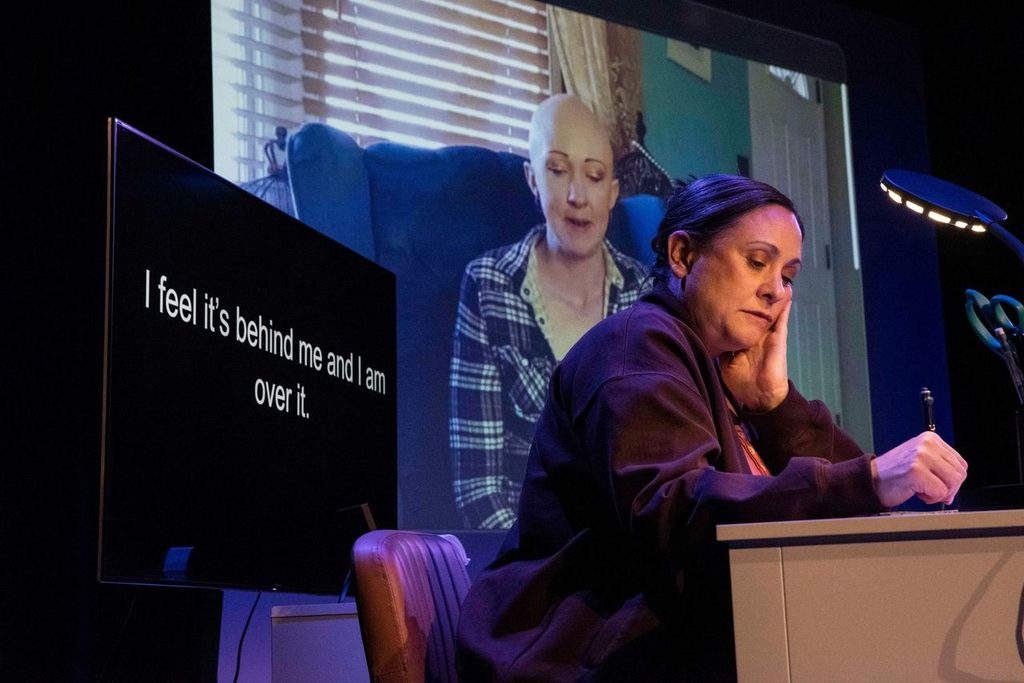
Adrienne Asterita as Sugar | Photography credit: Michael Ensminger Photography
Stacey D’Angelo’s direction keeps the production moving with a clear emotional through‑line, guiding Sugar’s journey while letting the flood of voices around her land with real weight. She shapes the chaos without smoothing it out, giving the show its pulse and its sense of accumulation. The video elements, directed by Phamaly Artistic Director Ben Raanan, deepen that rhythm — each face, each confession arriving with intention and adding to the growing chorus around Sugar. Together, their work creates a structure that holds the piece’s sheer scale, letting the story expand without losing its center.
This production finds real beauty in how it broadens the scope of Tiny Beautiful Things. Under Stacey D’Angelo’s direction, and with Ben Raanan shaping the vast constellation of video performances, the play expands far beyond its usual five‑ or six‑actor format. Adrienne Asterita anchors it all, surrounded by a multitude of voices that deepen the piece’s emotional reach and remind us how many people move through the world carrying questions, grief, and hope. It’s a thoughtful, resonant staging — one that hits every note it aims for and finds something genuinely moving in its widened lens.
Information and Tickets: https://phamaly.org/show/tiny-beautiful/