
Review: Misery
Posted by Curtain Up! on Sep 11, 2026
Review: Misery | Arvada Center | Arvada, CO | Curtain Up | Gina Robertson

When writer Paul Sheldon meets his number one fan in William Goldman’s stage adaptation of Stephen King’s novel Misery, the result is a tightly wound, intimate psychological thriller that steadily builds suspense and intrigue toward an explosive climax. This production succeeds through its ability to make a small space feel increasingly dangerous, claustrophobic, and impossible to escape.
There’s something particularly frightening about a horror story with no supernatural element that is rather a story involving ordinary people, something that could actually happen if the circumstances and personalities lined up just this way. Misery taps directly into that fear. Paul Sheldon, played by Geoffrey Kent, is a famous novelist driving through a snowstorm outside of Silver Springs, Colorado, when his car crashes into a canyon. Seriously injured and unable to save himself, he is rescued by Annie Wilkes (Jacque Wilke) who happens to live nearby. Annie brings him to her isolated farmhouse, nurses his broken body, and promises to care for him until the roads open up and the phone lines are repaired.
At first, it seems like Paul has been extraordinarily lucky. His biggest fan has found him, saved his life, and is eager to flatter and praise him while take care of him. But audiences quickly realize that his rescue is only the beginning of his nightmare. Once Annie’s admiration turns to obsession. Paul discovers that surviving the accident may have been the easy part.
Steven King has said that Annie Wilkes represents his drug addiction, how it lifted and comforted him at first only to turn on him until he was desperately living and working only to keep it at bay.
Scenic and Lighting Designers Brian Mallgrave and Shannon McKinney establish the production’s unsettling mood immediately with a creepy old farmhouse, dark and sinister, that glides and rotates to reveal the inner rooms where Paul spends most of the play recovering in bed from broken legs and a dislocated shoulder. The confined environment becomes an essential part of the storytelling. There is nowhere for Paul to go and, increasingly, nowhere for the audience to escape the tension either.
Kent captures Paul’s growing panic with remarkable restraint. Confined to a bed or wheelchair for much of the production, he must rely heavily on his voice, his face, and small gestures to convey pain, frustration, fear, and dark humor. His performance makes Paul’s physical helplessness palpable. We can see him calculating what to say to Annie, when to challenge her, and when to simply keep her calm enough to stay alive
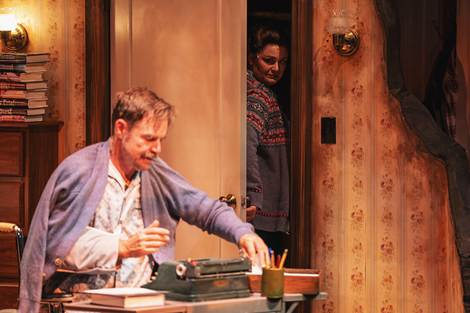
Geoffrey Kent and Jacque Wilke; Photo Credit: Amanda Tipton Photography
Kent also serves as the production’s Fight Director, and the physical staging pays off spectacularly. The climax is startling even for audience members who already know the story, demonstrating how effectively a familiar moment can be reimagined for the stage. The tension has been carefully constructed throughout the production, making the final confrontation feel both shocking and inevitable.
Wilke’s Annie Wilkes is equally compelling. Her performance takes Annie from seemingly benign rescuer to ridiculous fan-girl to brutal, unhinged captor. Clearly thrilled to have any company at all in her isolated home, but especially for it to be her favorite author, we can almost forgive her for wanting to keep him around as long as possible. Wilke finds the humor in Annie without diminishing the character’s menace. The relationship between Annie and Paul produces some genuinely funny moments amid the suspense and terror, creating an uncomfortable emotional roller coaster for the audience. We may laugh at Annie one moment and recoil from her the next. She really will do anything to keep him and to punish him if he displeases her. As the two of them work together writing Sheldon’s new novel, they develop an uneasy sense of companionship and familiarity, but the imbalance of power is always there.
Josh Robinson is Buster, the aw-shucks, folksy local sheriff who starts coming around to ask about the missing man whose car was found crashed nearby. Robinson gives Buster an appealing warmth and humor, but underneath his easygoing manner, his nose twitches with suspicion at Annie’s odd behavior and her strange purchases in town. It’s only a matter of time before Annie begins to see him as a problem.
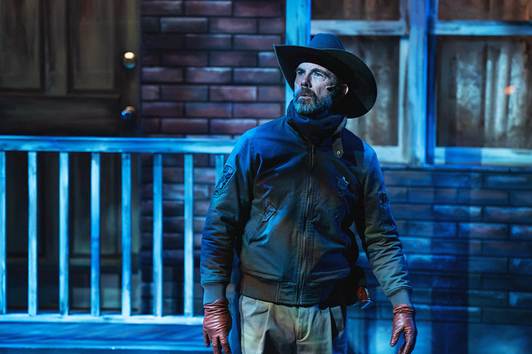
Josh Robinson; Photo Credit: Amanda Tipton Photography
It’s a terrific performance by this small cast, but the production’s technical elements deserve equal credit for creating its unnerving atmosphere. The set, lighting, hidden props and strategic costume reveals are what really set the tone of this show as a thriller. More than a few surprises are in store to make audiences gasp out loud. Director Lynne Collins keeps the actors perfectly cued and poised to create or relieve tension in the scene as they move about in the tiny house. In the scene where Paul has snuck into the kitchen to purloin a butcher knife to protect himself, the house smoothly rotates to show Annie plodding through the snow outside, around the house to watch him through the kitchen window. It is deliciously chilling.
Misery is the kind of theater experience that reminds us how powerful a live performance can be. There’s no substitute or special effect that can replace the experience of an entire audience gasping together in shock. If you enjoy the dopamine hit of a psychological thriller along with delightful, dark humor that will make you laugh, see Misery through October 11 at the Arvada Center.
For information and tickets: https://arvadacenter.org/events/misery