
Review: Julius Caesar
Posted by Curtain Up! on Jun 30, 2026
Review: Julius Caesar | Colorado Shakespeare Festival | Boulder, CO | Curtain Up! | Gina Robertson

Let us praise Julius Caesar, not bury it. A slick, frenetic production that captures the attention in a death grip, this version focuses on issues like modern day news cycles, women in leadership roles, and ubiquitous social media updates. The stage is bracketed by projection screens running continuous feeds of breaking news coverage and smartphone footage with video clips and hashtags designed to keep us enthralled, watching for the next development. The show starts with #CaesarReturns as a press gaggle forms for the spectacular entrance of the man and his entourage.
Director Shelly Gaza drives this ancient story expertly through a modern lens, capturing the hectic pace and distracting nature of smartphones and media-made publicity. It is a 400-year-old play written about 2000-year-old events, but this story of ambition, betrayal, and controlling the narrative fits perfectly into our world. We know these personalities.
Joe Hilsee as Caesar swaggers and poses: smooth, full of confidence and charisma as befits a man whose name came to mean “king” in two dozen languages. He represents a certain type of politician: media savvy, photo ready, wary of men with a lean and hungry look who think too much.
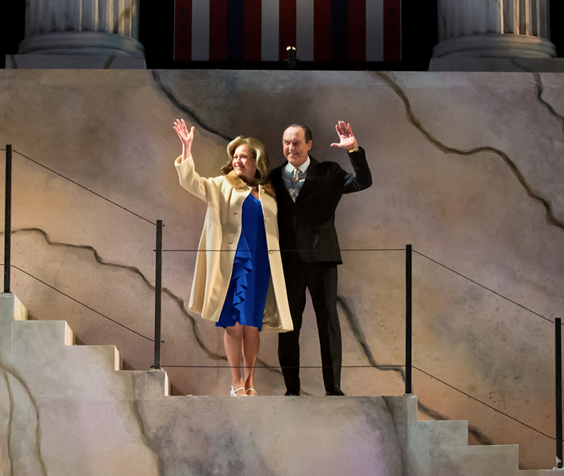
Laurie Keith and Joe Hilsee; Photo Credit: Jennifer Koskinen
Brutus (Karen Slack) and Antony (Antionette Robinson) are played by women, which adds an element of striving to both of their characters, that extra effort that women must put forth to be taken seriously in a man’s world. When pitted against each other, both are sympathetic characters. As Gaza says in her director’s note, women who operate within this system “find themselves compelled to navigate, reinforce or weaponize the very hierarchies they might wish to dismantle.”
Slack’s Brutus is tightly wound, anguished at the necessity of killing a man she loves. She clearly forces her emotions aside to use her formidable courage and reason to push through the trauma. This costs her not only her own life in the end but the life of her wife Portia and their unborn child.
As Antony, Robinson is crafty and courageous, navigating the tides of civil unrest in circumstances where she might be killed as easily as Caesar. In the famous funeral scene, she rouses the crowd with quiet charisma alongside genuine emotion. She succeeds where Brutus fails because she embraces her womanly emotions and stands in righteousness with no self-doubt.
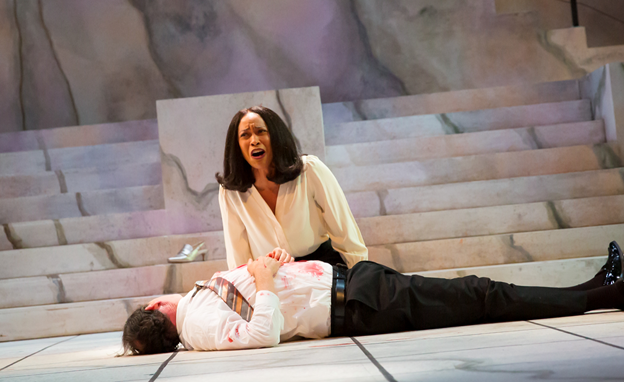
Joe Hilsee and Antionette Robinson; Photo Credit: Jennifer Koskinen
Cassius (Benjamin Reigel) is a competent conspirator with a hidden gift for comedic timing. Jihad Milhem as Casca has a funny moment or two as the conspirators can’t help taking themselves too seriously and looking silly in the process.

Benjamin Reigel and Karen Slack; Photo Credit: Jennifer Koskinen
Tyler Cox comes in as Octavius Caesar with a noteworthy performance as Caesar’s avenging heir. Madison Taylor as a heavily pregnant Portia meets both the emotional and physical challenges of the role.
Costumes by Sarah Zinn are stylish and neat: business suits and expensive casual fashion followed by active wear and camo cargo pants suggesting military fatigues, and all of it vaguely suggesting power with a hip Roman flavor.
The set is visually stunning: marble steps and Roman columns, designed by Kevin Nelson. Breathtaking effects are accomplished with lighting by Katie Gruenhagen, sound design by Jason Ducat and mesmerizing projection design by DJ Pike. The death of Cinna the Poet (Kyle Lawrence) is an especially compelling scene that starts out on stage but then proceeds off stage as the mob chase him down while the audience watch in horror the phone camera footage displayed on the projection screen, climaxing with a sudden eruption and fade to blood. Only when it’s over do we realize we could not look away from this brutal mob murder brought about by misinformation and conspiracy theory.
The size of the set and the relentless pace of the action combine to establish a sickening inevitability in the events as they unfurl. Given human nature and these personalities, no other outcome is possible.
When Shakespeare wrote Julius Caesar in 1599, boys played the women’s parts, and all the players were white Englishmen, but it seems he might have understood his play would be performed one day by women of color in a new world and that the story would still resonate powerfully. As Cassius says, “How many ages hence / Shall this our lofty scene be acted o’er / In states unborn and accents yet unknown.”
Catch this excellent show at the Colorado Shakespeare Festival in its 69th season, Roe Green Theater on the CU campus in Boulder.
Information and tickets: https://cupresents.org/show-details/julius-caesar-6