
Review: Divine Bull Transformation
Posted by Curtain Up! on May 19, 2026
Review: Divine Bull Transformation | Veritas Productions at Pluss Theatre | Denver, CO | Curtain Up! | Eric Fitzgerald

Veritas Productions unveils the world premiere of Divine Bull Transformation at the Mizel Arts and Culture Center’s Pluss Theatre, where playwright Mia Burnett gathers six souls whose deaths span from ancient Pompeii to the present day. In this metaphysical holding pen—part celestial waiting room, part moral sorting facility—director Nancy Evans Begley guides the ensemble through a series of reckonings overseen by an undisturbed, persistent facilitator. The result is an afterlife that feels less like doctrine and more like a curious, often wry examination of what we carry with us long after the body is gone.
Burnett’s conceit is a clever one: by assembling the newly dead alongside those who perished longer ago, she treats the afterlife less as a moral sorting hat and more as a long‑running human archive. The play’s tension comes not from who will be sent where, but from how these disparate lives rub up against one another—how guilt, denial, humor, and longing persist even when time no longer does. The facilitator’s task, as it turns out, is less about judgment than about coaxing each soul toward a truth they’ve spent years, or millennia, refusing to face.
Burnett’s gift lies in the people she puts onstage. Each soul arrives fully articulated—shaped not only by the circumstances of their death but also by the habits, blind spots, and emotional weather systems they carried through life. There’s a satisfying firmness to these portraits; they don’t wobble or blur as the play unfolds. If some exchanges land exactly where you expect them to, the writing mostly steers clear of cliché, allowing the characters’ histories and temperaments to drive the dialogue rather than the other way around.
It’s an auspicious debut for Burnett, a self‑described Denver‑based Chicana and Jewish playwright whose voice already shows a clear sense of purpose. Divine Bull Transformation reaches for the big, unruly questions—identity, consequence, the long tail of a life—and folds in quieter examinations of mental health and grief that give the piece its emotional ballast. It’s a thoughtful first outing, and it will be interesting to see where she goes next.
Director Begley has assembled a remarkable cast drawn largely from familiar faces in the Denver theatre scene. At the center is Matthew Combs as Rafael, the facilitator, who brings a blend of inquisitiveness and quiet authority to the role. He keeps the afterlife’s holding pen from tipping into chaos, guiding—and occasionally corralling—the six souls in his charge as they inch toward whatever comes next.
The production’s real strength, though, is the ensemble. Together they give this liminal space its texture—by turns volatile, funny, wounded, and unexpectedly tender—and their interplay keeps the afterlife from feeling abstract. It’s the kind of collective work where every performer deepens the world simply by being fully, recognizably human within it.
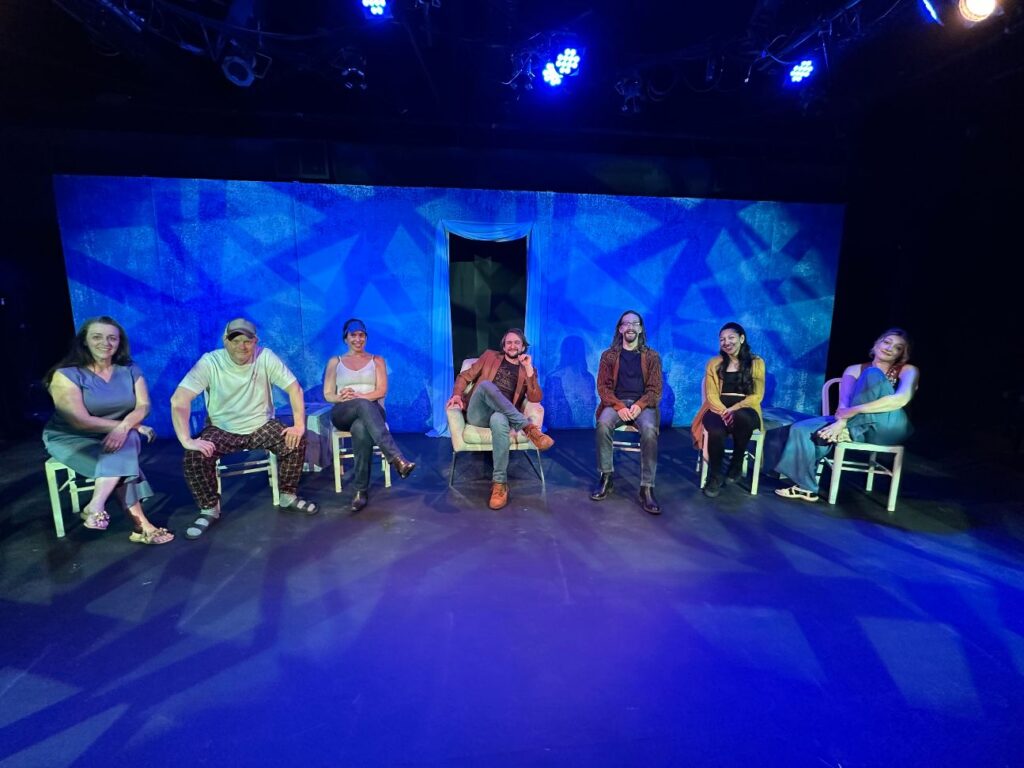
L to R: Jennifer Burnett, Eddie Schumacher, Ali Chung, Matthew Combs, Grey Dumois, Iliana Lucero Barron, Abigail Kochevar | Photo credit: Nancy Evans Begley
Ali Chung as Joanna—an actor whose work I consistently admire—delivers a performance here that is no exception; she charts Joanna’s unraveling with a taut, deliberate precision, making her Act Two break feel like a sudden drop into open air. Iliana Lucero Barron’s Alex brings a restless, contemporary spark, the kind of quick‑firing energy that keeps everyone else on alert. Abigail Kochevar, as Julia, threads a surprising vulnerability through the character’s sharper instincts, letting us glimpse the soft underbelly beneath the bite.
Jennifer Burnett’s Laverne offers a grounded, lived‑in warmth, even as she needles the group with the kind of well‑intentioned irritation that only someone deeply familiar can get away with. Eddie Schumacher’s Tim leans into his character’s compulsive chatter—about food, about his still‑living wife—with a comic specificity that makes the repetition feel human rather than broad. Grey Dumois as Chris provides a quiet steadiness that deepens as the story bends around him, his reserve becoming unexpectedly affecting.
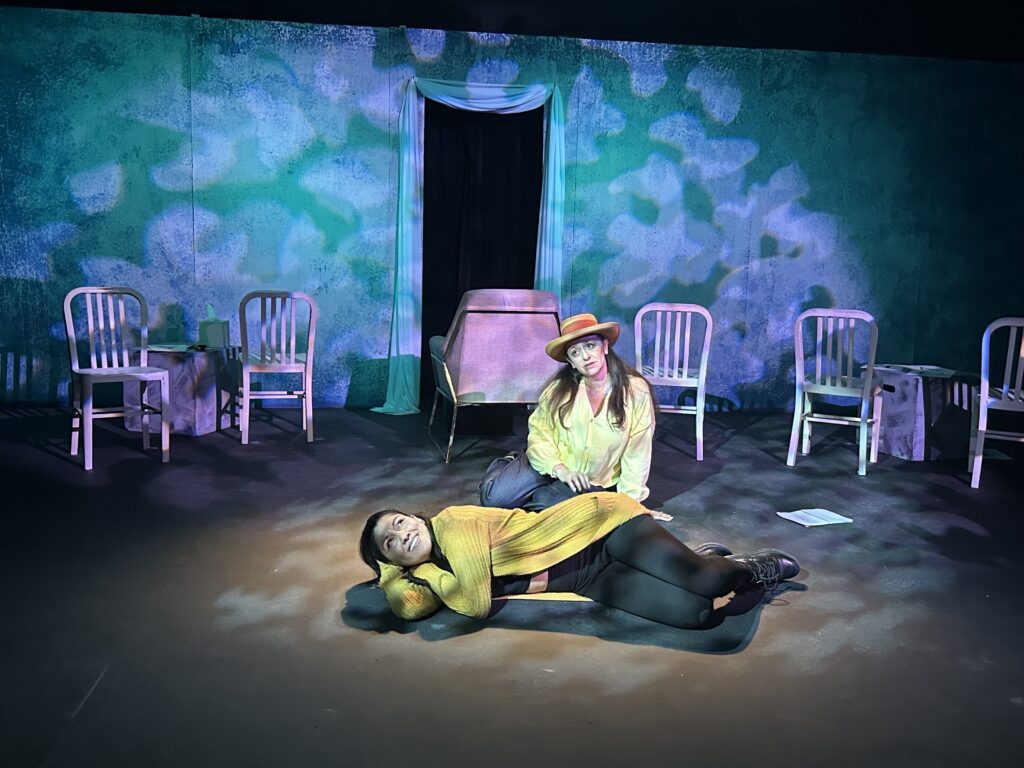
L to R: Iliana Lucero Barron, Jennifer Burnett | Photo credit: Nancy Evans Begley
It’s a script that asks a great deal—shifts in tone, era, and emotional temperature—and this ensemble rises to those demands with a shared clarity of purpose, shaping six distinct lives that collide in the same strange corner of the afterlife.
Nancy Evans Begley directs with a steady, confident hand, shaping the production with an intuitive understanding of what the playwright is reaching for. There’s clarity to her storytelling that reflects a genuine bond with the material—she seems to know when to lean into the play’s emotional currents, when to let a moment breathe, and when to tighten the focus so the stakes land cleanly. In addition to directing, she also serves as executive producer and designs both the set and costumes, and that multi‑hyphenate role results in a production that feels unified in tone and intention. The scenic design is deliberately spare: a single upstage doorway, framed by a simple arrangement of chairs, creating a threshold space that’s suggestive without being literal. Her costumes are equally thoughtful—unshowy but quietly expressive, each offering small visual cues about the lives the characters have stepped out of. Begley’s work throughout reveals a director attuned to the play’s shifting emotional and temporal layers, guiding the piece with confidence that allows its deeper questions to surface with clarity.
Brett Maughan’s lighting design proves integral to the production’s overall impact. A prolific presence in the metropolitan area, Maughan brings the kind of assured, finely calibrated touch that has become a hallmark of his work. Here, his cues shape the atmosphere with quiet authority—subtle shifts that guide the audience through changes in time, tone, and emotional temperature without ever calling attention to themselves. Complementing that is Curt Behm’s audio design, which provides a steady, unobtrusive undercurrent that supports the play’s transitions and emotional beats with precision. Together, their work deepens the production’s world, giving it visual and sonic coherence that carries the story forward.
With Divine Bull Transformation, playwright Mia Burnett offers a new work that feels both ambitious and inviting, the kind of world premiere that reminds you how exciting it is to encounter a story at the moment of its first full breath. Under Nancy Evans Begley’s assured direction—and supported by a cast that meets the play’s demands with clarity and commitment—the production finds a cohesion that speaks well for its future life. Produced by Veritas Productions, Divine Bull Transformation proves to be a rewarding evening in the theatre, one that lingers not for its spectacle but for its ideas, its craft, and the promise of what may come next.
For information and tickets: https://tickets.jccdenver.org/tickets/divine-bull-transformation-a-world-premiere-351850