
Posted by Curtain Up! on Apr 07, 2026
Review: Angels in America: Perestroika | Vintage Theatre | Aurora, CO | Curtain Up! | Eric Fitzgerald

Angels in America: Perestroika—Part 2 of Kushner’s monumental, Pulitzer‑winning epic—premieres at Vintage Theatre under Troy Lakey’s steady, straightforward direction, advancing the story from Millennium Approaches and plunging its characters, and us, into the feverish chaos of the saga’s second half. I first saw Perestroika on Broadway, in the production that went on to win the Tony Award for Best Play, and experiencing it again here—scaled differently, but just as intense—carries its own emotional charge. This production is powerful, anchored by performers who meet the material with clarity and conviction. And Perestroika still asks what it has always asked: stamina. You lean in, stay engaged, and surrender to three and a half hours of expansive, probing, often volcanic theatre.
When Angels in America: Perestroika first appeared on Broadway in 1993, it wasn’t just the continuation of a story, it was a reckoning. America was still in the grips of the AIDS crisis, still avoiding its own reflection, and Kushner’s second chapter refused to let anyone look away. If Millennium Approaches opened the era, Perestroika entered the wreckage and questioned what survival, justice, and change might cost. More than thirty years later, the play hasn’t softened. Its questions about power, community, and the delicate work of imagining a livable future still resonate strongly, especially in a country that keeps revisiting the same wounds. That’s the enduring message of Perestroika: it reminds us that progress is messy, nonlinear, and always contested—and that imagining a better world remains the most radical act we can undertake.
Perestroika picks up in the immediate aftermath of Millennium Approaches, with Prior Walter (Casey Board) battling both his failing body and the Angel’s (Kelly Uhlenhopp) explosive demand that he becomes a prophet. Louis (Dakota Hill) and Joe’s (Chad Hewitt) relationship buckles under the weight of politics and guilt, while Harper (Nicole Kaiser) slips deeper into her dreamworld and Belize (Johnathan Underwood) tries to steer both Prior and a dying Roy Cohn (Andrew Uhlenhopp) toward something like grace. Into this chaos steps Hannah Pitt (Haley Johnson), Joe’s mother, newly arrived in New York, whose steadiness and unexpected compassion help tether several characters as the world tilts. The play follows these intertwined paths through visions, confrontations, and fragile alliances as everyone gropes toward forgiveness, change, and the possibility—however tentative—of a world remade.
Anchoring this production is Andrew and Kelly Uhlenhopp, a married duo whose presence has become vital to the Denver theater scene. They deliver performances capable of tilting a small stage on its axis. Kelly’s Angel is fierce, sometimes funny, and remarkably human—she hits with both celestial power and emotional precision. Andrew’s Roy Cohn is an all-controlled fire, charismatic and corrosive in equal parts, a portrayal that keeps the audience from retreating into comfort. Together, they remind us of what happens when two artists at their peak encounter material that demands everything: the epic becomes intimate, and the intimate becomes seismic.
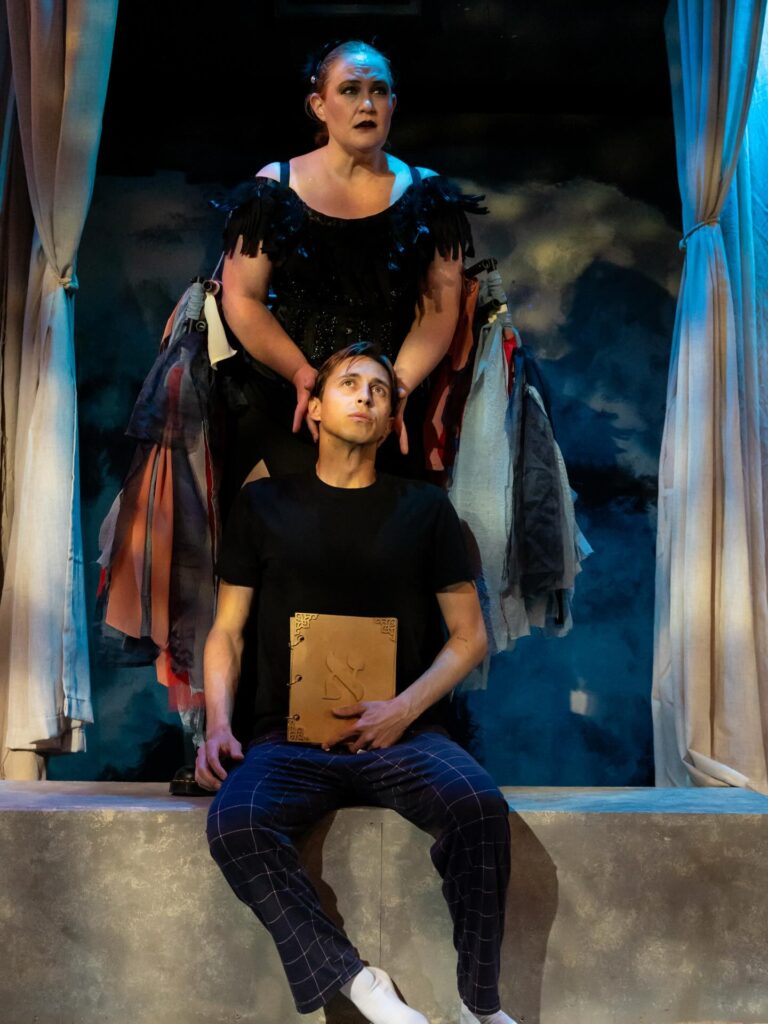
Back to Front: Kelly Uhlenhopp (Angel), Casey Board (Prior Walter) | Photography credit: RDG Photography
Also central to Perestroika is Johnathan Underwood, whose work as Belize is nothing short of riveting. He brings fierce emotional intelligence to the role—challenging Cohn with sharp, unflinching moral clarity while providing Prior with a steadiness that feels both hard-won and deeply human. Underwood delivers a smoldering performance, shaped as much by his silences as by his words; the way he listens, absorbs, and holds the space around him becomes its own form of eloquence. Those quiet moments—measured, weighted, alive—are where his craft shines brightest, revealing an actor who understands that restraint can be as powerful as revelation.
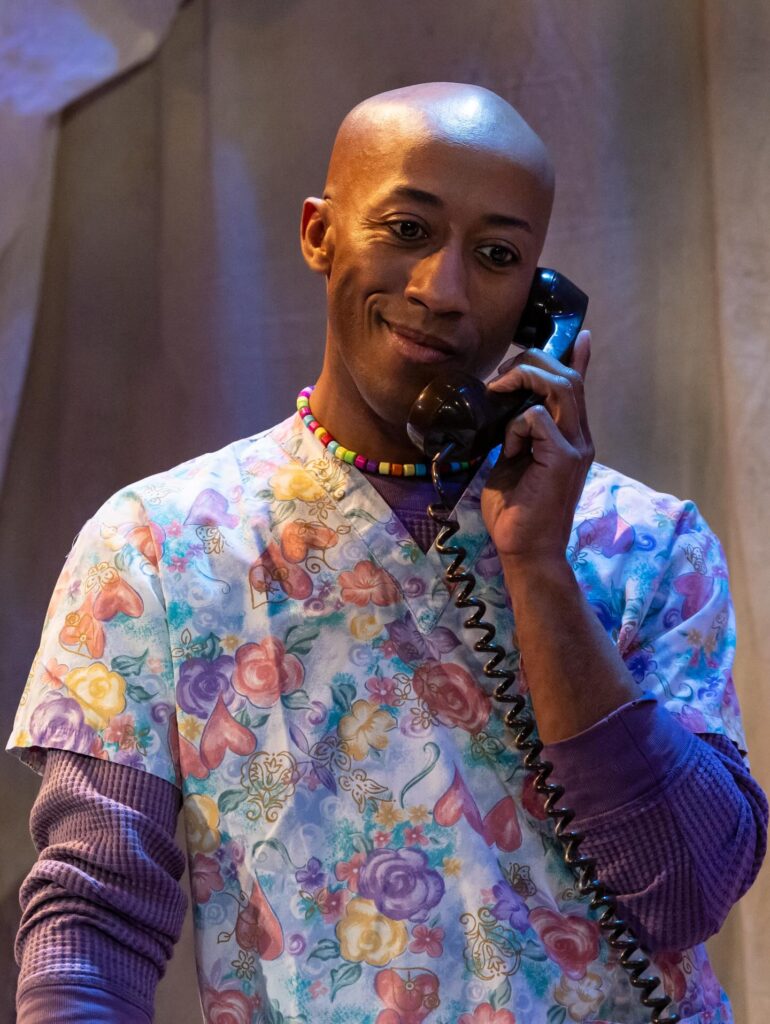
Johnathan Underwood as Belize | Photography credit: RDG Photography
The rest of the cast is equally impressive. Casey Board depicts Prior Walter’s descent and resilience with sharp emotional clarity, grounding the play’s wildest moments. Chad Hewitt portrays Joe Pitt with a quiet, internal struggle that deepens scene by scene—he’s playing a man at war with himself, and you can sense the toll in every hesitation, every swallowed truth. There’s moral and emotional tension in his performance that makes Joe’s unraveling truly compelling. Dakota Hill’s Louis embodies restless intellect and raw nerves, a man who can’t stop thinking,
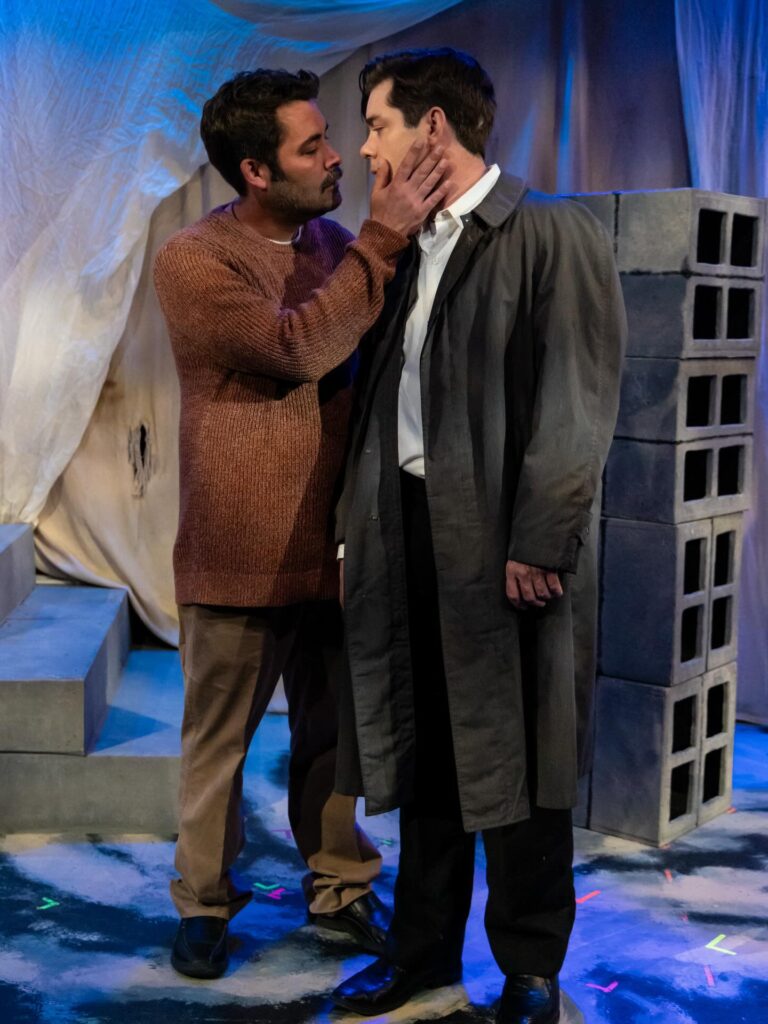
L to R: Dakota Hill (Louis), Chad Hewitt (Joe) | Photography credit: RDG Photography
even at the cost of everything. Nicole Kaiser gives Harper Pitt a fragile immediacy, allowing her to drift and return with a kind of wounded wonder. Haley Johnson, playing both Hannah Pitt and Ethel Rosenberg, turns in two distinctly lived‑in portraits—one shaped by a plainspoken, practical toughness, the other by a quiet, uncanny stillness that somehow manages to linger in the room, as if politely refusing to leave.
Troy Lakey, along with assistant director Austin Jensen, deserves genuine credit for shaping Perestroika into something coherent, energetic, and emotionally clear, especially for a play this expansive. His direction keeps the audience engaged for over three and a half hours, guiding the story with a clarity that maintains its complexity. He balances the epic and the personal skillfully, trusting the actors to carry the energy while ensuring the overall structure stays solid. From my seat in the back row, I noticed a few low-to-the-floor scenes were harder to see, but they can be easily fixed in such a small space—yet it’s a minor point in otherwise confident, thoughtful staging. Lakey makes sense of Perestroika without oversimplifying it, and that’s no small achievement.
The physical production again rests on Brendan T. Cochran’s smart, utilitarian set—an adaptable framework that gives Perestroika the room it needs to expand and contract without ever losing the actors inside it. Jasper Day’s costumes continue to reveal character with understated precision, and the Angel’s black‑leather look adds a jolt of danger and authority that suits this chapter of the story. Emily Maddox’s lighting once more guides us through shifting realities with clean, expressive control, and Patrice Mondragon’s sound design deepens the play’s tonal landscape without overwhelming it, adding in musical treats from the era. Together, these elements create a cohesive world that supports Kushner’s epic without competing with its scale.
Troy Lakey’s direction and the across‑the‑board excellence of this ensemble make Vintage’s Angels in America a rare accomplishment—ambitious, coherent, and deeply felt. Experiencing both Millennium Approaches (directed by Bernie Cardell) and Perestroika (directed by Lakey) is undeniably a commitment, not just in hours but in the willingness to meet Kushner’s world with openness and stamina. Yet Vintage rewards that commitment at every turn. What Lakey and this cast deliver is a reminder of what theatre can still do at close range: challenge, unsettle, illuminate, and ultimately leave you changed.
Information and tickets: https://www.vintagetheatre.org/performances/angelsinamerica