
Posted by Curtain Up! on Apr 07, 2026
Spotlight: Divinely, Alone | The Three Leaches Theater | Lakewood, CO | Curtain Up! | Gina Robertson

Three Leaches Theater hosted a special VIP sneak peek of Divinely, Alone: A Picnic with Divine by Mike Broemmel in April, including a talk back session with Broemmel, director Greg West and actor John-Christian “JC” Maheu. The play is scheduled to premiere in May at the Clock Tower on the 16th Street Mall in Denver. The following month, Divinely, Alone will be one of the Main Stage Plays at the first ever Lavender Hill Theatre Festival, also in Denver.
Divinely, Alone is a tribute and deep dive into the life and filthy mind of an iconic American drag queen, Divine, whose given name was Harris Glenn Milstead. Known as the “Queen of Filth,” Divine portrayed Edna Turnblad in the original film version of Hairspray, establishing a tradition of placing male actors in that role. Divine was the inspiration for Ursula the Sea Witch in the animated film The Little Mermaid.
In this world premiere, Maheu as Divine comes out blazing hot with a discussion of possibly her most controversial and filthiest act, leaving viewers to question whether they heard correctly – did she say she ate dog shit? Or she hates dog shit? Did she say it was performed in glorious “odorama”? Indeed, Divine may be best known for eating a fresh dog turd at the end of 1972 cult film Pink Flamingos as the character Babs Johnson, “the filthiest person alive.” It was done for real, unsimulated, filmed on the streets of Baltimore. The odorama connection, however, was a scratch and sniff card created later for audiences to scratch and sniff along with Divine in a 1981 film Polyester.
Such outrageousness secured Divine’s place in the American queer and punk culture imagination, and Broemmel opens his play with these most controversial acts as a way of establishing for modern viewers the shock value Divine had just in her persona, when just being a drag queen was shocking.
The preview performance featured two scenes from the seven-scene full production in which Divine narrates her life story in gyrating, singing, moaning, shouting, living color. Maheu captures the boldness of Divine, the toughness, while in his sensitive blue eyes there are hints at vulnerability. In her muumuu caftan and clownish make-up, Divine is a cartoon but Glenn Milstead is a real person whose talent is responsible for Divine’s legendary success. Broemmel calls it “drag as defiance” and describes Divine as “utterly uninterested in being likeable,” but Maheu shows us that the man inside the Queen felt rejection and suffered for it. He describes a fine line between playing Divine vs. playing Milstead, going from camp to comedy to vulnerability in the same scene.
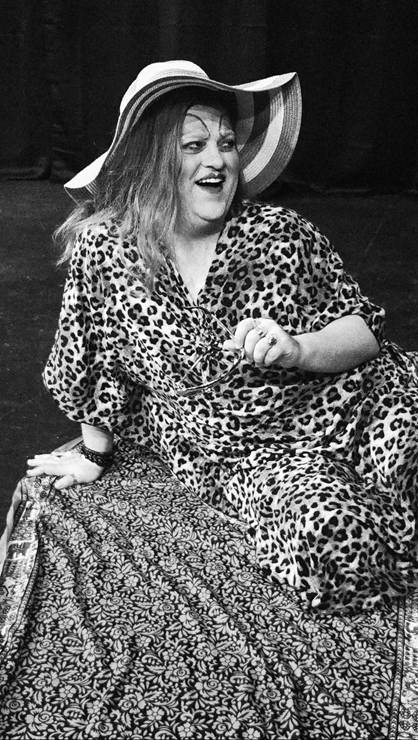
JC Maheu | Photo Credit: Mike Broemmel
Broemmel was inspired to write this play when a perceived assault on drag queens began several years ago. In many places, conservative groups lobbied to ban drag shows in public places and to stop drag queen story hour at libraries and bookstores. His teen years were memorably influenced by midnight movie queens Dr. Frank-N-Furter and Divine, who both celebrated being different in a world determined to “sand down the differences” instead.
The preview at Three Leaches provided a glimpse at the inner workings of a new play in its genesis. About midway through rehearsals, the setting is to be imagined, a cemetery where Divine appears at her own gravesite ready to have a picnic. “I don’t own the place, but I’m always here,” she says. Sassy, larger than life, she struts out, munching on a fried chicken leg, and stakes out a place on the stage like she did decades ago in show business. She defends her space aggressively while pictures from her life are projected onto her tombstone.
While viewers process the opening bit, she moves on to list and mime the eight indecencies forbidden by censors and performed by her: exhibitionism, masturbation, vomiting, voyeurism, sodomy, castration, cannibalism and the climax from the final scene in Pink Flamingos, the one involving the dog. This sequence leaves no doubt about the personality on display here, and subsequent monologues covered the childhood and young adulthood of Milstead in Baltimore where he became a beautician and started dressing as a woman.
Watch for the full production by Theatrix USA and Act One Productions at the Lavender Hill Theatre Festival in June. Other biographical plays to be performed there will be The Wind is Us: the Death that Killed Capote, I’m Harvey Milk, and An Echoing Spring: A Story of Matthew Shepard.